Kauaʻi is the oldest of the major Hawaiian islands. While islands like Oʻahu and Maui show their volcanic youth with sharp ridges and tall peaks, Kauaʻi has had millions of years of extra rain, wind, and gravity to reshape it. Everything here feels more carved, more weathered, and more settled into itself.
People call it the “Garden Island,” and that’s accurate – it’s indeed incredibly green – but that nickname doesn’t tell the whole story. Kauaʻi isn’t just lush; it’s deep. The valleys are deeper, the cliffs are older, and the landscapes feel like they’ve been through things. This is the island where erosion has had the most time to work, and Waimea Canyon is the clearest example of that.
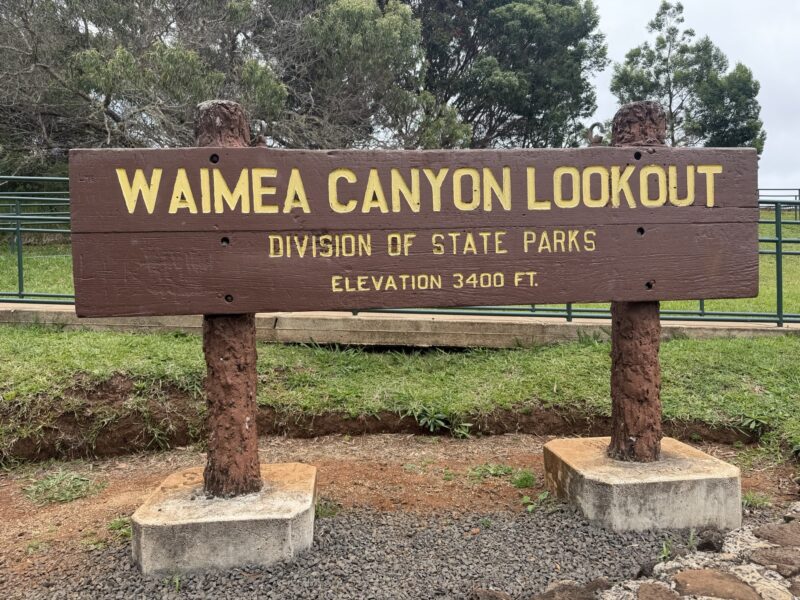
Waimea Canyon sits on the western side of Kauaʻi, far from the beaches and resorts. Getting there means driving inland, climbing in elevation, and watching the island change around you. It’s one of the few places in Hawaiʻi where you’re not looking out at the ocean — you’re looking into the island itself. It’s one of the few places where you can literally see how an island forms, collapses, rebuilds, and erodes over millions of years.
Poke: Hawaiʻi’s Most Casual, Yet Most Iconic Food
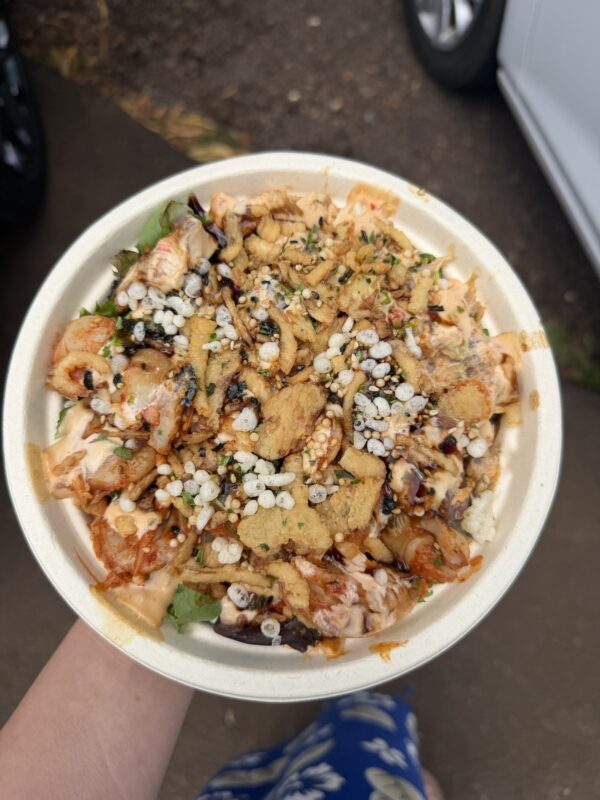
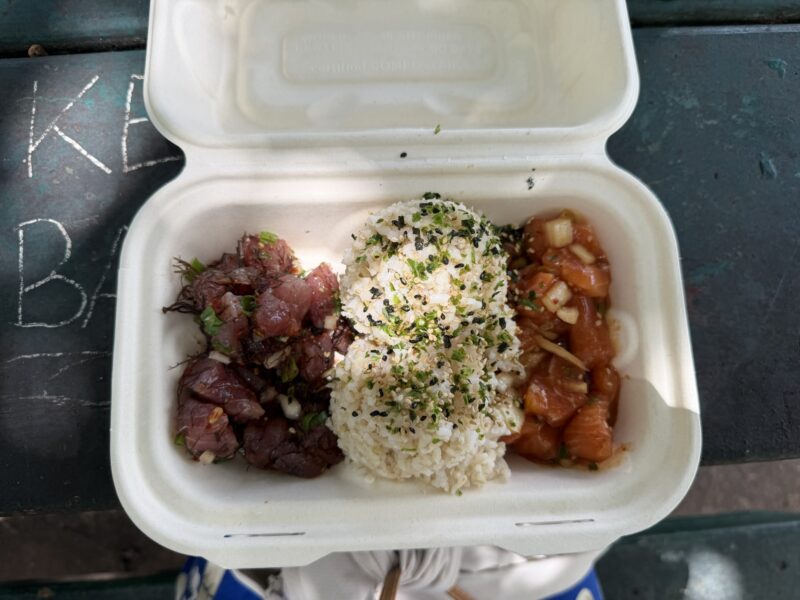
We had the brilliant idea of picking up poke and eating it overlooking Waimea Canyon. It felt like the perfect plan: fresh fish, big views, and a little “this is how locals do it” energy. So we stopped at a little poke shop in Lihue before driving up — because when you’re in Hawaiʻi, you HAVE to try the poke.
Poke is one of those foods people instantly associate with Hawaiʻi, and there’s a reason for that. It’s not a trend here. It’s not a “dish.” It’s part of daily life. Long before poke bowls became a mainland obsession, Hawaiians were cutting up reef fish, tossing it with sea salt, limu (seaweed), and roasted kukui nut, and eating it the way you’d eat anything fresh and good — immediately.
Poke is one of those foods that feels completely tied to Hawaiʻi, and for good reason. Long before it became a mainland trend, poke was something Hawaiians made with whatever they had on hand: freshly caught reef fish, sea salt, limu (seaweed), and roasted kukui nut. The word poke literally means “to slice” or “to cut crosswise,” which is exactly what it is — raw fish cut into cubes, seasoned simply.
Over time, especially with Japanese and other Asian influences, poke evolved. Now you’ll find versions with soy sauce, sesame oil, onions, chili, furikake, and every combination in between. But the heart of poke hasn’t changed: fresh fish and a few ingredients that make sense together. It’s casual food, but it also tells you a lot about Hawaiʻi — its fishing culture, its history of immigration, and the way local traditions adapt without losing their roots.
And bot it’s good!! The fish is cool and silky, the seasoning is just enough to wake it up, and every bite feels so fresh and cool. Perfect for lunch any day.
Driving Up the Mountain
The drive up is straightforward but steep. Unlike the Road to Hāna, you’re not dealing with endless curves or one‑lane bridges. Instead, you climb steadily from sea level into cooler air, passing through dry lowlands, red dirt slopes, and eventually pine forests. Kauaʻi’s microclimates stack themselves vertically, and you can see each one as you gain elevation.
There are several free overlooks along the way. We saw plenty of cars pulled over, and I’ve heard the views are great. We didn’t stop at them ourselves because we were heading for the official lookout inside the state park.
Lunch: No Picnic Tables, but “Yay” to Functional Bathrooms!
When we reached the main Waimea Canyon Lookout, we realized our brilliant plan to eat poke with a canyon view had one fatal flaw: there were absolutely zero picnic tables. Not one. We briefly considered eating it right at the railing, but it didn’t feel right. The idea of a rogue napkin blowing into the canyon felt like a personal crime against nature. So, we just ate our Poke standing in the parking lot. Not ideal, but it worked out fine. Fresh poke, cool mountain air, and the anticipation of seeing something great.
And then came the real surprise: the bathrooms. After a few very disappointing public restroom experiences in Hawaiʻi, we were pleasantly surprised to find functional bathrooms here — clean, stocked, and flushing. Oh how are standards have changed 😂.
Seeing the Canyon for the First Time
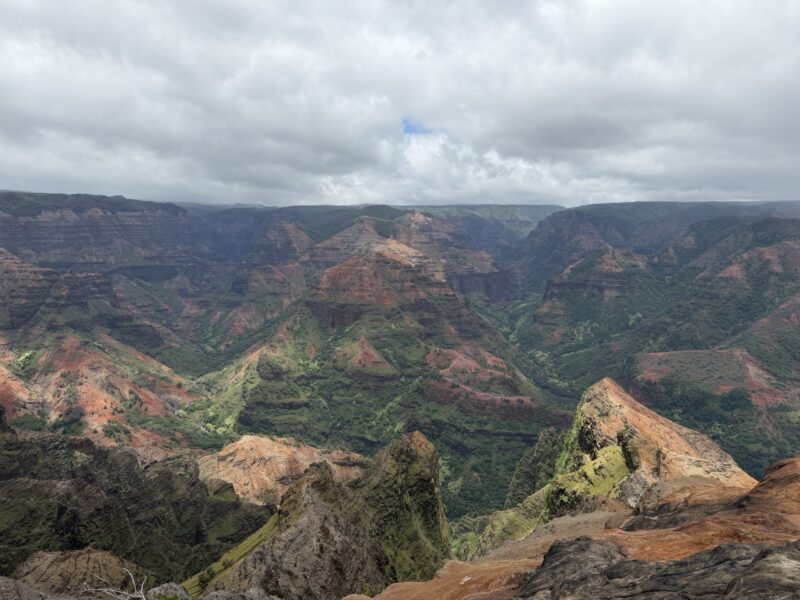
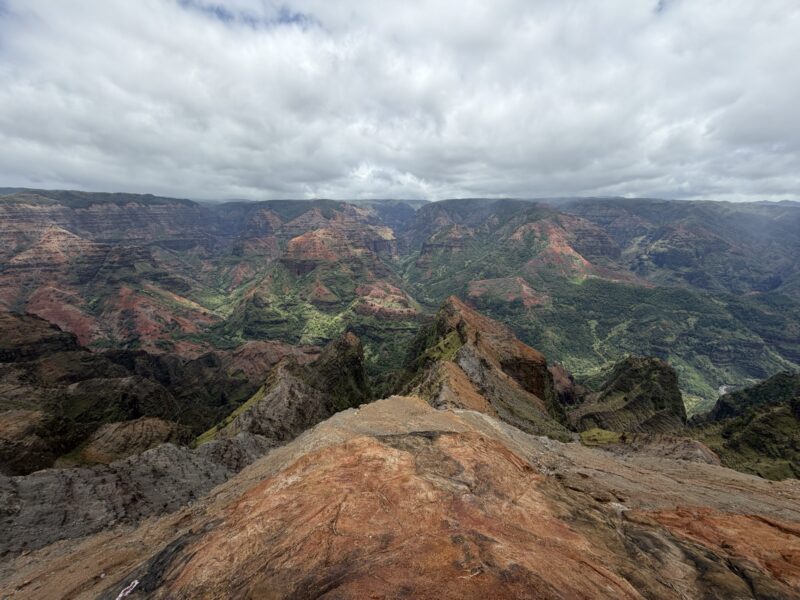
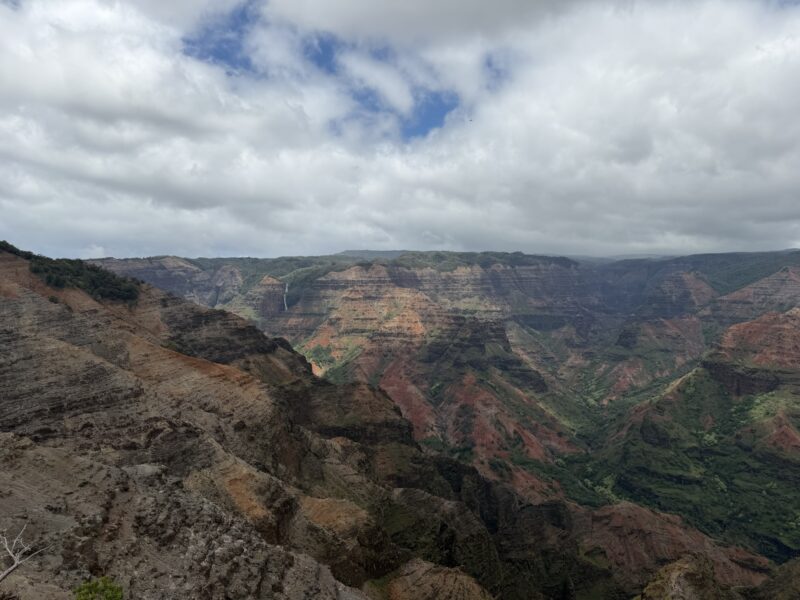
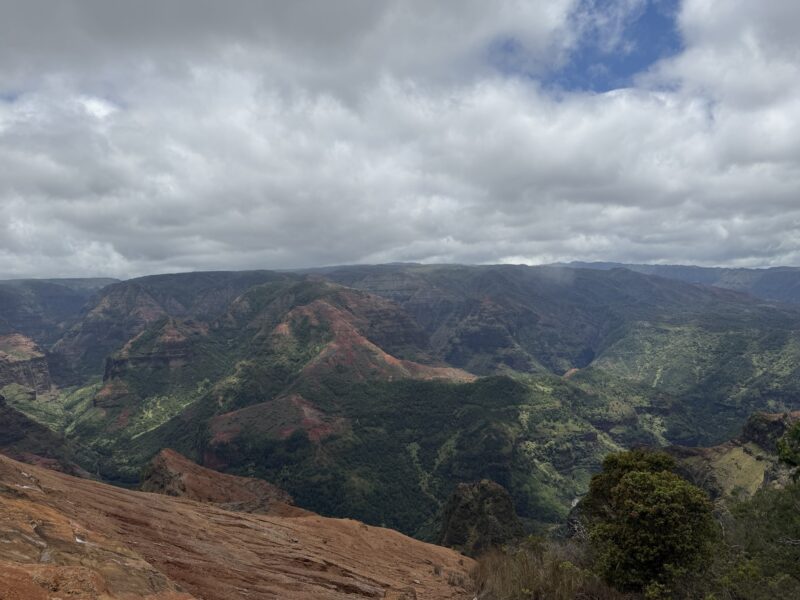
After our parking lot lunch, we walked up the path to the overlook.
When you walk up to the railing and the canyon finally opens in front of you, it’s hard not to pause. The scale hits first — the width, the depth, the way the ridges fold into each other like a giant, open book. The colors shift constantly: red rock that looks almost rusted, green ridges clinging to the cliffs, deep shadows that make the valleys feel endless, and every now and then a thin waterfall slicing through the layers.
While we were standing there, another visitor exclaimed aloud, “This is absolutely the most beautiful place I’ve ever seen.” .. and I think he’s not wrong. You’re looking at the island’s bones — the layers, the faults, the history written in rock.
What You’re Actually Looking At
Standing at the railing, it’s easy to get swept up in the beauty of Waimea Canyon, but what you’re really looking at is the island of Kauaʻi’s entire life story laid open in front of you. Kauaʻi was formed by a massive shield volcano over five million years ago, and ever since, the island has been shaped and reshaped by water, wind, and surf. Waimea Canyon is the most dramatic example of that slow, relentless sculpting.
The canyon itself was created through a combination of volcanic shifting and water cutting through layers of basaltic lava. Kauaʻi’s lava is porous and crumbly — some of the most intensely weathered lava in the world — which makes it especially vulnerable to erosion. Over millions of years, rain from the lush upland forests above the canyon walls carved deeper and deeper into the rock, exposing the island’s interior like a cross‑section.
Waimea Canyon stretches more than 13 miles long, about 1.5 miles wide, and drops up to 2,500 feet deep. It runs roughly east–west across the island, which is why the light changes constantly — the sun hits the walls differently throughout the day, shifting the colors and shadows in real time.
Those horizontal stripes you see on the canyon walls aren’t just pretty; they’re layers of ancient lava flows, stacked one on top of another over the last 4–5 million years. The red tones come from varying levels of iron oxide — basically volcanic rock that has rusted over time. The darker layers show different chemical compositions of lava, each one marking a different eruption in Kauaʻi’s past.
Even the vegetation tells a story. Trees only grow where there’s enough water and soil, which is why the lower slopes are green while the ridge tops stay dry and bare. If you look closely, you can spot native koa trees with their silvery, sickle‑shaped leaves and kukui trees with their pale green, almost powdery foliage. They’re some of the easiest plants to recognize from a distance, even in a landscape this huge.
Note: Nothing in this post is sponsored, gifted, or paid for. We buy our own snacks, wait in our own lines, and form our own opinions the old‑fashioned way — by actually being there. If we mention a place, product, or experience, it’s simply because we thought it was interesting enough to share.
Read more of Mimi’s posts about Hawaii:

🖋️Writer Spotlight: Mimi
🇺🇸 Hawaii (April 2026 Postcard)
🇺🇸🌺 A day in Maui: Road to Hāna
🇺🇸🌺Spam, Rice, Repeat: Why Hawaii Loves Spam!
🇺🇸🌺Chickens, Chickens Everywhere 🐔😲
🇺🇸🌺The Hula Lesson and the Quiet Wound Beneath Hawaiʻi’s Beauty