
Hello everyone! Greetings again from my home in India! ✨
After the intense, spiritual energy of Varanasi, my parents and I took a quick road trip down to Jaipur—the famous “Pink City” in the desert state of Rajasthan! (Fun fact: it got that nickname back in 1876 when the Maharaja painted the entire old city terracotta pink – the traditional color of hospitality – to welcome the visiting UK Prince of Wales, and by law, those historic buildings are still kept pink today! 🌸🏰)
Now, when most people think of Jaipur, they imagine grand royal palaces, elephant rides, and colorful bazaars. And yes, we have all of that! (including the elephant rides!)😉 But the place that completely blew my nerdy brain away and made me feel so proud of our history – was a UNESCO World Heritage site called Jantar Mantar!
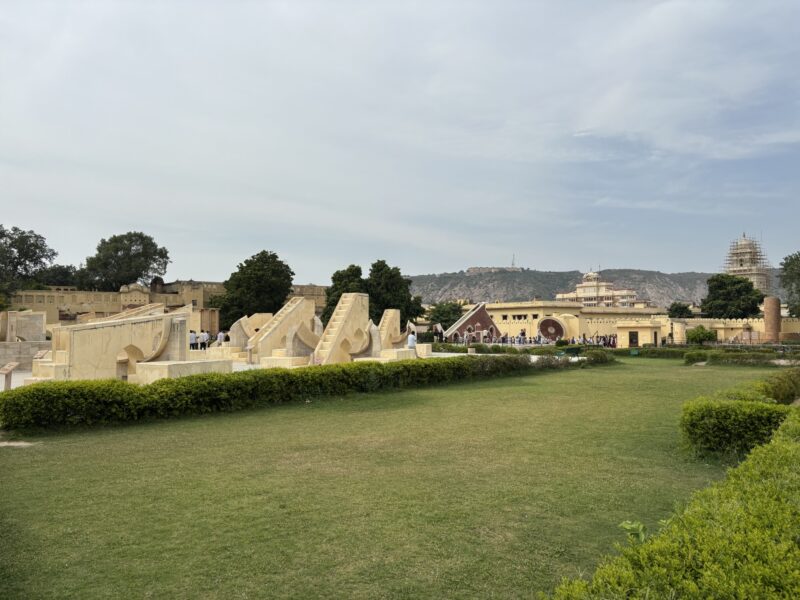
When you first walk in, it looks like a giant outdoor modern art park filled with massive, geometric sculptures made of marble and local stone – huge staircases leading to nowhere, giant bowls sunk into the ground, and towering triangles.
Except these aren’t sculptures at all! They are 300-year-old astronomical instruments built to measure time, track stars, and predict eclipses using only shadows and sunlight! Let me break down the fascinating story behind this place – no science degree needed, I promise! 😄👇
First: Who Built This, and Who Were the Jaipur Royals? 👑🕌
To understand Jantar Mantar, you have to meet Maharaja Sawai Jai Singh II.
Back in the 1700s, long before India became a single unified country, India was made up of powerful kingdoms and empires. Jaipur was ruled by the Kachwaha Rajput royal family, legendary warrior-kings famous for their massive hilltop forts, incredible palaces, and love for art and learning.
Maharaja Jai Singh II (who founded the city of Jaipur in 1727) wasn’t just a king, he was a total math and astronomy genius! He collected astronomical books from all over the world – from ancient Indian scholars, Persian and Islamic astronomers, and even European scientists – and decided to build five giant open-air observatories across North India. The one in Jaipur is the largest and best-preserved of them all!
Why Was Astronomy So Important Back Then? 🌟📅
You might wonder: “Anjali, why would a king spend a fortune building giant stone calculators in the 1700s?”
Back then, there were no weather apps, GPS satellites, or digital calendars! Knowing the exact movement of the sun, moon, and stars was critical for everyday survival and ruling a kingdom:
- Farming & Monsoons: India depends heavily on seasonal monsoon rains. Accurate calendars told farmers the exact right week to plant and harvest crops.
- Predicting Festivals, Eclipises & Sacred Dates: Almost all Indian festivals and religious ceremonies are based on a lunar-solar calendar – so royal astronomers had to calculate the exact positions of the moon and planets years in advance.
- Royal Horoscopes & Lucky Dates (Muhurat): The biggest reason is that in royal courts back then, astrology dictated everything. Whenever a royal baby was born, court scholars had to map the exact positions of the sun, moon, and planets at the precise minute of birth to cast their horoscope (Kundli) and predict their future destiny, health and rule. Kings wouldn’t dream of planning a royal wedding, crowning an heir, launching a military campaign, sign a treaty, or lay the foundation of a new city without checking the stars for the most auspicious date!
How Do Giant Stone Buildings Measure the Sky? (In Broad Daylight!) ☀️📐
Maharaja Jai Singh II realized that the existing star charts of the 1700s had drifted out of sync with the real sky over the centuries. And if those planetary tables were inaccurate, every royal birth chart and auspicious date would be off! So, he decided to build massive stone instruments to measure the exact positions of the sun and planets down to a fraction of a degree.
Back then, astronomers followed one simple rule: the bigger the instrument, the more accurate the reading! If a small handheld sundial is off by a tiny fraction of a millimeter, you lose whole minutes of accuracy. Make that sundial 90 feet tall, and suddenly you can tell the time down to two seconds!
And here is the coolest part that completely blew my mind: most of these instruments work during the day, when you can’t even see a single star! At night, anyone can look up and spot constellations. The real genius of Jantar Mantar was figuring out which constellation the sun was passing through right in the middle of a bright, sunny afternoon – using nothing but shadows!
Now Imagine a royal baby has just been born in the Jaipur palace at 2:00 PM on a bright sunny afternoon! A messenger races over to the observatory so the royal astronomers can immediately cast the baby’s birth chart (Janam Kundli):
Step 1: Record the Exact Minute of Birth → Samrat Yantra (The Giant Sundial) ⏳🔺
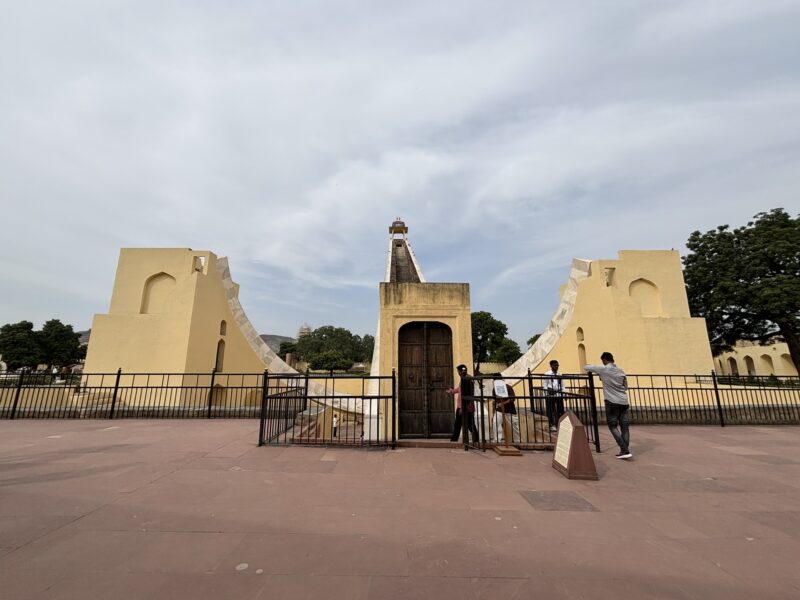
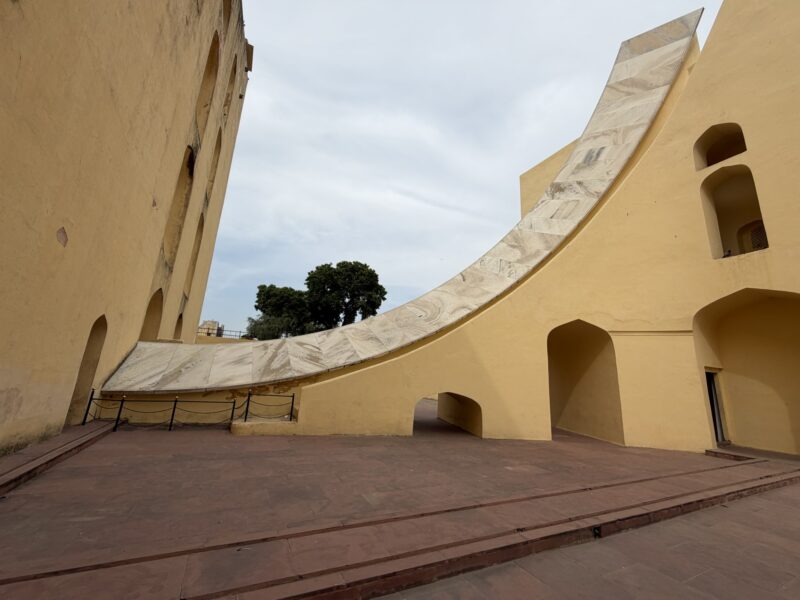
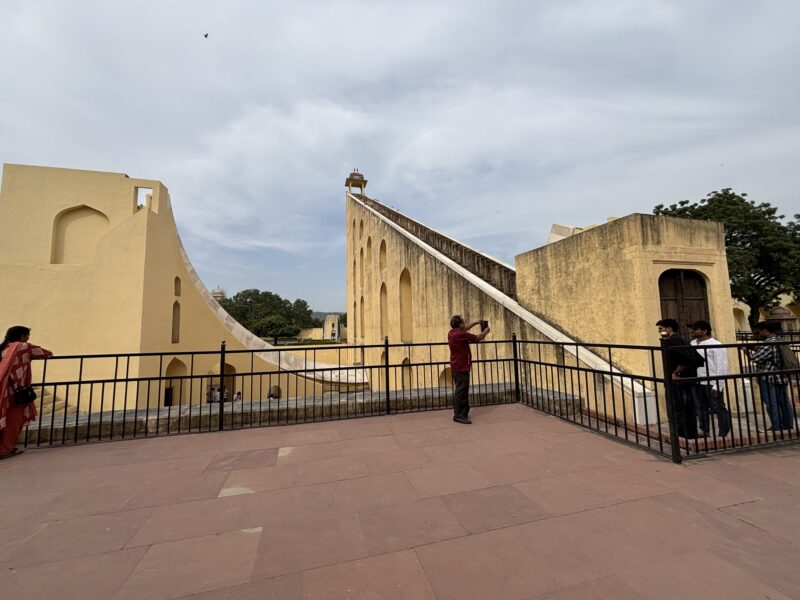
First, the astronomers need the exact timestamp of the royal birth! They rush to this massive triangular wall standing 27 meters (nearly 90 feet) tall – the world’s largest stone sundial.
- How it works: The angled edge of the giant triangle is built at the exact latitude of Jaipur (27 degrees), pointing straight at the North Star. As the sun moves across the sky, the triangle casts a crisp shadow onto two curved marble arcs on either side.
- Mind-blowing fact: The shadow moves about 1 millimeter every second – you can literally stand there and watch time move in real time! Even today, 300 years later, it still works and measures local Jaipur solar time to within two seconds of accuracy!
- Wait – Why Didn’t It Match My Phone? 📱😄: When you checked the shadow against your smartphone clock, you might notice it’s off by a few minutes. It’s not because the sundial is broken, it’s because the sundial measures true local Jaipur time. Today, all of India runs on a single unified time zone (Indian Standard Time, which is calculated from a longitude further east near Mirzapur) – so if you adjust for the longitude difference, that 300-year-old stone triangle is still dead-on accurate!
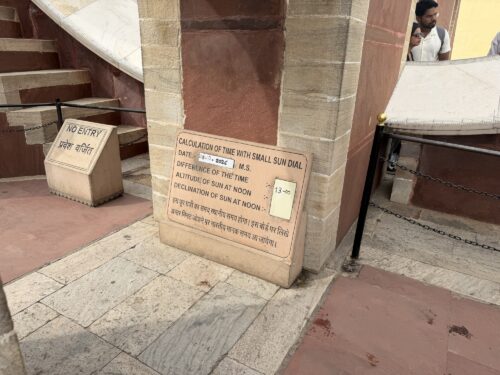
Step 2: Find Which Zodiac Sign the Baby Was Born Under → Jai Prakash Yantra (The Sunken Bowls) 🥣✨
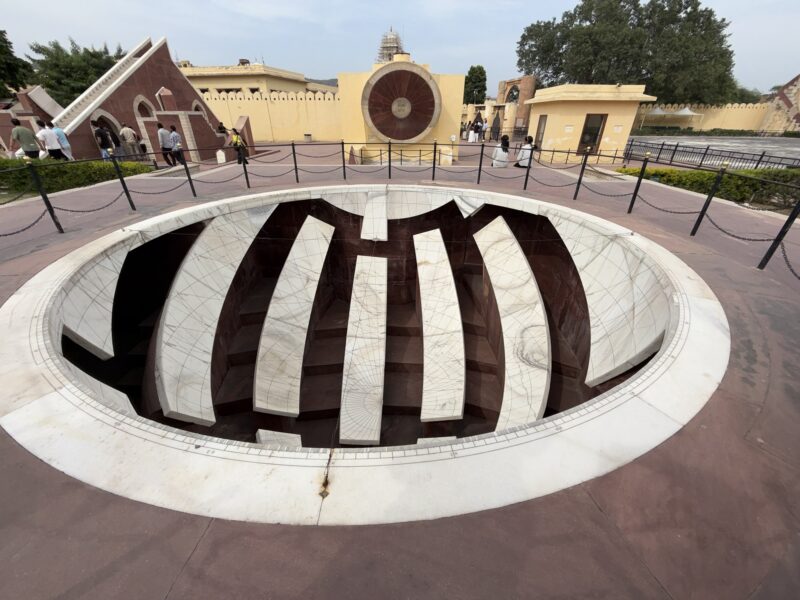
Now that they have the exact birth time, they need to know which zodiac constellation the sun is passing through at that moment—even though the afternoon sky is completely bright blue and not a single star is visible! So they walk over to a pair of huge, sunken marble bowls carved right into the ground.
- How it works: Imagine taking the entire sky and mapping it upside-down inside a giant bowl. Crosswires stretched across the top of the bowl cast a tiny shadow onto the curved marble floor inside, which is engraved with star maps and zodiac zones. Wherever that tiny shadow lands reveals exactly which zodiac constellation is sitting right behind the sun at the moment of the baby’s birth!
- Why Are There Two Bowls With Cutouts? When you look closely at my photo of these bowls and you’ll notice deep pathways carved right into the marble – almost like missing puzzle pieces. Because the bowls are so big, astronomers had to actually climb inside them to read the tiny shadow up close. Cutting walkways into the marble gave them stairs to stand on, but it meant removing parts of the engraved sky map. The genius solution? Build two twin bowls side-by-side with alternating cutouts! Whenever the shadow falls into an empty walkway in the first bowl, the astronomer simply steps over to the second bowl, where that exact spot is solid marble!
Step 3: Pinpoint the Exact Coordinates Inside That Zodiac Sign → Rashivalaya Yantra (The 12 Zodiac Triangles) ♈♌♐
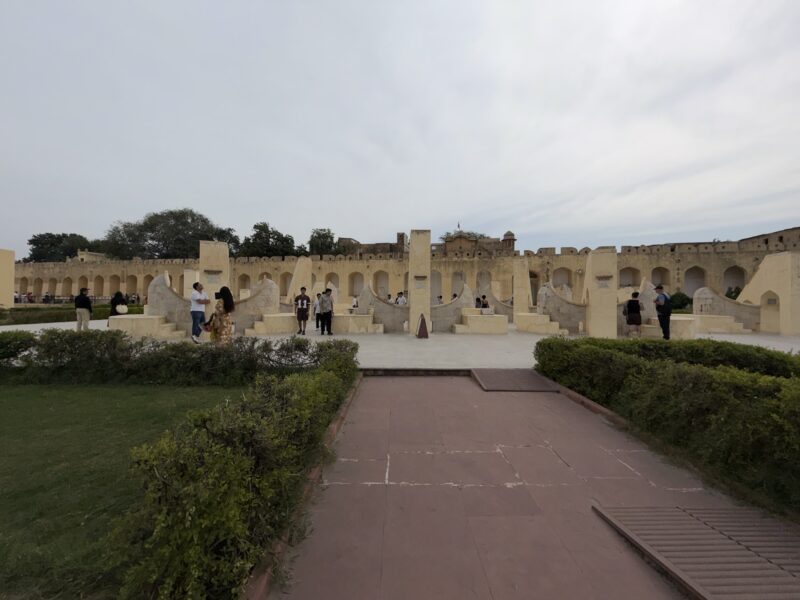
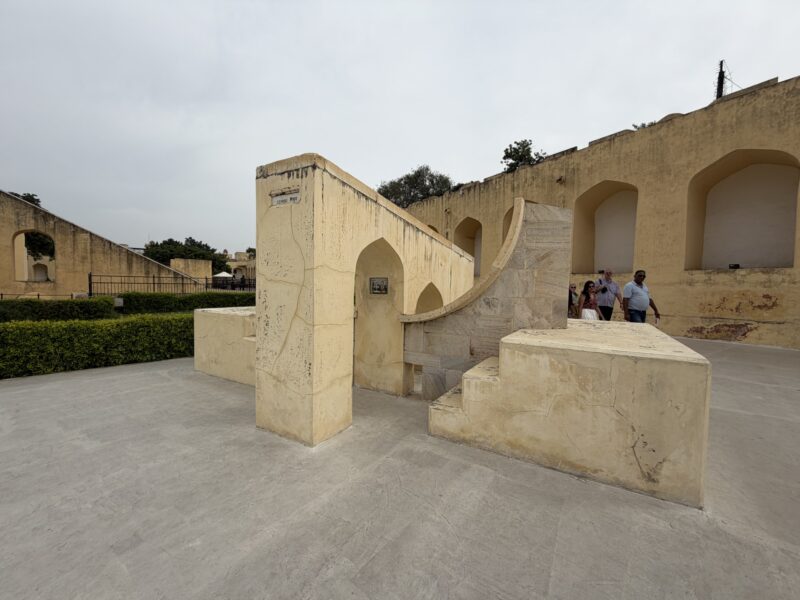
Once the sunken bowls reveal which zodiac sign the royal baby was born under (say, Leo or Sagittarius), the astronomers need an even sharper, zoomed-in reading for the birth chart. They walk over to a cluster of 12 smaller angled triangles – one dedicated to each of the 12 signs of the zodiac!
- How it works: Each triangle is tilted at a slightly different angle to match one specific zodiac constellation. The astronomer steps up to the exact triangle matching the baby’s zodiac sign, and its shadow gives a super-precise reading of the sun’s exact position within that constellation!
Step 4: Complete the Astrological Chart → Ram Yantra (The Circular Star Trackers) 🏛️⭕
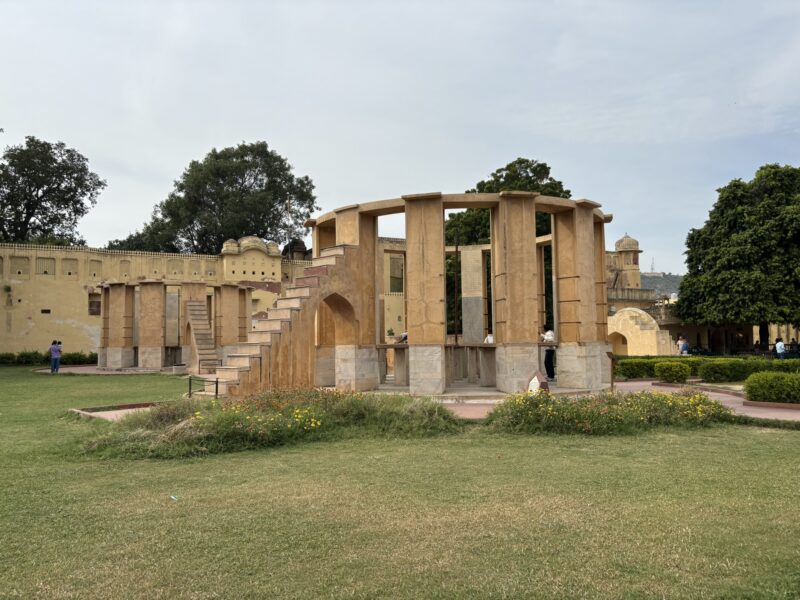
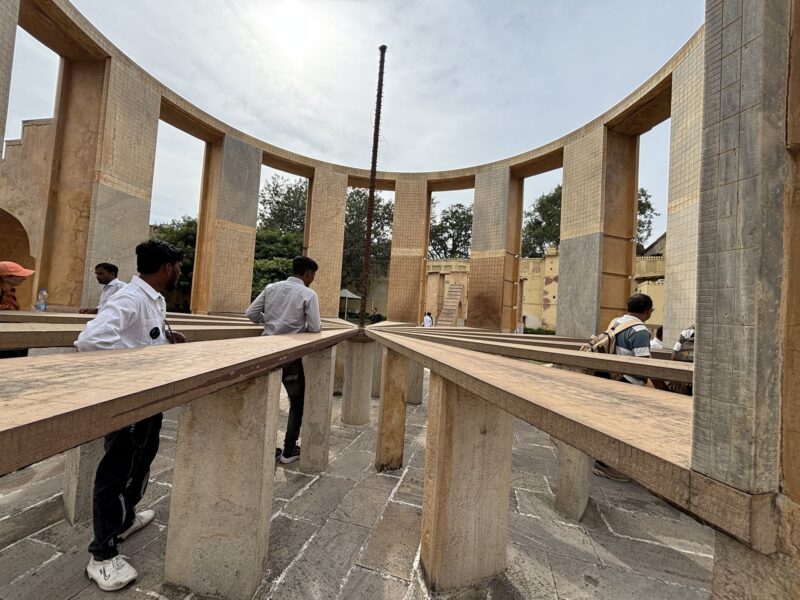
You can’t build a royal birth chart with just the sun – astronomers also needed to map the exact positions of the Moon and visible planets (like Jupiter, Mars, and Saturn), plus double-check the horizon angles to see which zodiac sign was rising in the East at the moment of birth! For that, they used these two open-air cylindrical buildings, each with a tall pillar right in the center and stone gaps cut out like spokes on a wheel.
- How it works by day: The central pillar casts a crisp shadow onto the engraved stone floor and walls, giving two exact numbers for the sun: how high it is in the sky (which confirms the exact season and calendar date) and its exact compass direction. (And just like the sunken bowls, there are two twin cylinders with alternating gaps so the shadow never disappears into a walkway!)
- How it works by night: Once sunset hits and the stars appear, the Ram Yantra pulls double duty – astronomers stand inside those same gaps and line up their eye from the central pillar toward the Moon and visible planets to finish mapping the entire royal horoscope!
Standing there in the warm Jaipur sunshine, watching that shadow creep millimeter by millimeter across 300-year-old marble, I’m so impressed at what Indian engineers, mathematicians, and artisans achieved centuries ago using pure geometry, stone, and sunlight.
I am not affiliated with or sponsored by any places, brands, or organizations mentioned in my posts. All views expressed here are purely my own! 💛