Note
This article discusses death rituals in India. Content may not be suitable for all audiences.
In my last post, I shared the importance of the Ganges River to all Hindus and how she is the source of life. Today, I want to talk about the other side – death – one of the most sacred things in our culture.
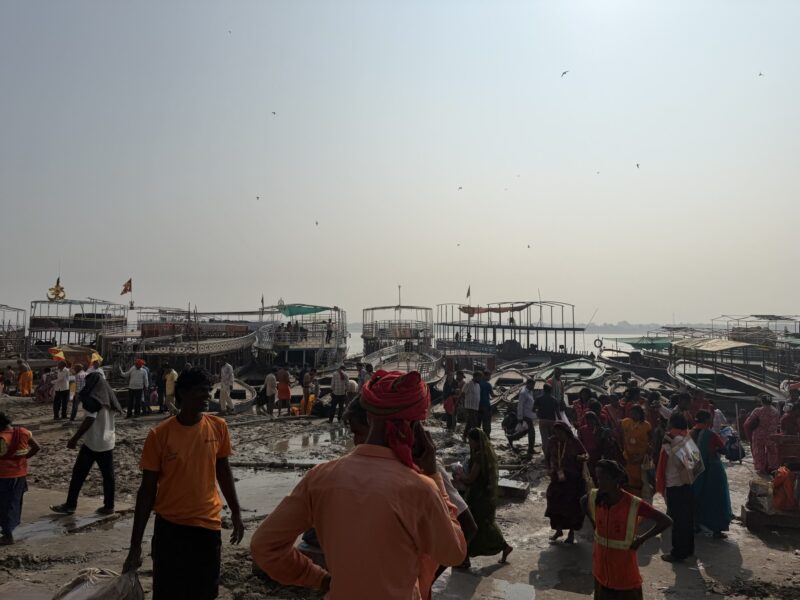
While walking along the riverbanks with my parents, we passed by Manikarnika Ghat and Harishchandra Ghat – the famous cremation river banks where funeral pyres have been burning 24 hours a day, 7 days a week, for thousands of years without stopping.
For most people around the world, death is a scary taboo filled with silence and fear. But here in Kashi (Varanasi), death is met face-to-face with peace, devotion, and the belief in Moksha – the final liberation of the soul.
The “Salvation Hotels” (Mukti Bhavans) 🏨🙏
Growing up in a Hindu family, you hear this from your grandparents right from childhood: we believe in the cycle of birth, death, and rebirth (samsara). Every soul keeps taking new births until it works through its karma and achieves moksha – freedom from that cycle, uniting with the Divine.
And in our tradition, dying in Kashi (Varanasi) and having your last rites performed right on the banks of Maa Ganga grants instant moksha! That is why, for centuries, elderly Indians from all over the country have traveled to Varanasi in their final days – not out of sadness, mind you, but out of deep spiritual readiness.
Salvation Hotels are simple, peaceful charity guesthouses where elderly people who know their time is near come to stay with their families while waiting to pass away peacefully. There are no fancy hotel amenities here – just basic, clean rooms, priests chanting sacred mantras, and the constant sound of temple bells. Families sit together, sing devotional songs (bhajans), offer drops of Gangajal (Ganges River water) and Tulsi (holy basil) leaves, and help their loved ones let go calmly. And because space is super limited, guests are allowed to stay for two weeks only. If they don’t pass away within those 14 days, they gently return home to make room for someone else – and believe it or not, sometimes people feel so peaceful there that their health actually improves!
What Happens at the Cremation Ghats 🔥🪵
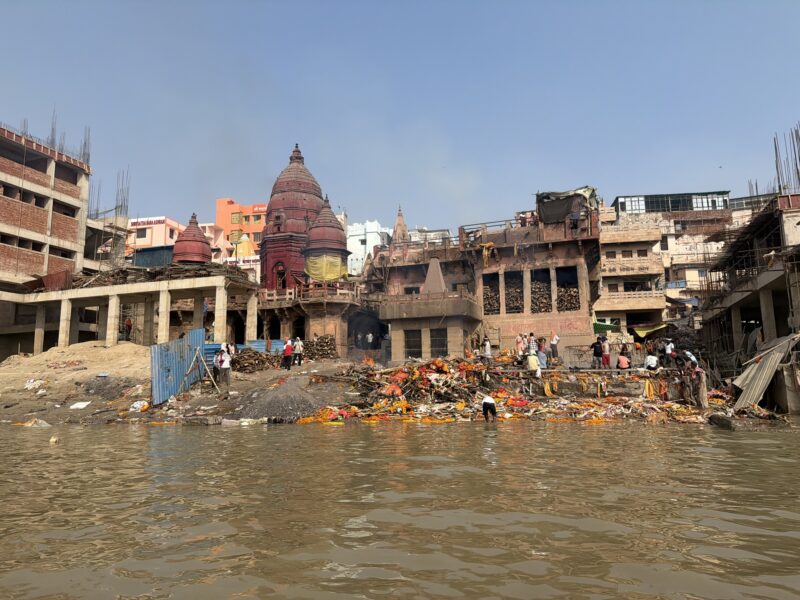
A funeral procession in Varanasi is completely different from a quiet, black-suit funeral in the West. First is the procession (Antim Yatra). Family members walking briskly carrying a loved one wrapped in bright marigold garlands and white, red or saffron cloth on a bamboo stretcher, chanting “Ram Naam Satya Hai” (“The Name of God is the Only Truth”). Before the cremation, the body is dipped one last time into the sacred waters of the Ganga for purification. Then stacks of sandalwood are arranged carefully. The eldest son (or close male relative) shaves his head as a sign of humility, walks around the pyre, and lights it using the eternal sacred fire – a flame that, according to tradition, has been kept burning continuously for millennia!
In traditional Hindu custom, women do not participate in the actual cremation at the burning ground – we say our final goodbyes at home before the procession leaves. I remember when my own grandfather passed away in Delhi; my mom, my aunts, and I stayed back with the women of the family while my dad and male cousins went to the cremation ground to perform the last rites. While things are slowly changing in modern cities today, ancient ghats like Manikarnika still follow this tradition strictly – so today, as a woman, I simply observed quietly from a respectful distance.
Even if someone passes away in other parts of India, like Delhi or Mumbai, or abroad, families travel to Varanasi or Haridwar (that’s where my own family went for my grandfather) to immerse their loved one’s ashes into the Ganga, praying for their soul’s peaceful onward journey.
In our fast-paced modern lives in cities, we spend so much energy chasing promotions and worrying about small things. Varanasi gently reminded me that life is temporary, love and duty to family are everything, and returning to the elements is nothing to fear.
I am not affiliated with or sponsored by any places, brands, or organizations mentioned in my posts. All views expressed here are purely my own! 💛