
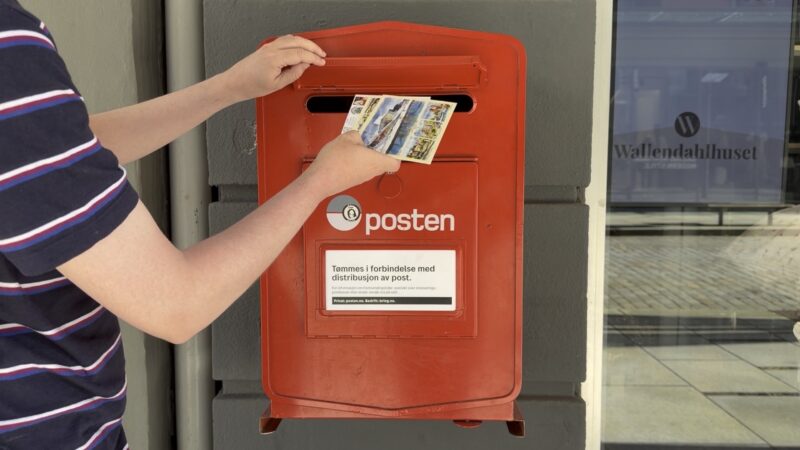
I was fortunate to have the chance to travel across Norway, from Oslo in the east to Bergen in the west and watched a nation slowly reveal different sides of itself — the polished capital, the quiet farm valleys, the impossible fjords, and finally the salt-washed old port.
Oslo: The Calm Capital
I began in Oslo, a capital hemmed in by forest and fjord. I did what I always do in a new city: I went looking for its stories in its museums. Oslo has them in abundance – the Fram Museum which was literally built around the actual polar ship that carried Nansen and Amundsen into the ice at both ends of the earth; the open-air Norwegian Museum of Cultural History, where I stepped inside an årestue, a smoke-darkened single-room farmhouse with an open hearth and a ljore hole in its turf roof, and wandered up to its incredible Gol Stave Church; the great Vigeland sculpture park, where Gustav Vigeland’s stone figures wrestle, embrace, and rage at one another; and, of course, Munch’s The Scream, which is somehow both smaller and more unsettling in person than you expect.
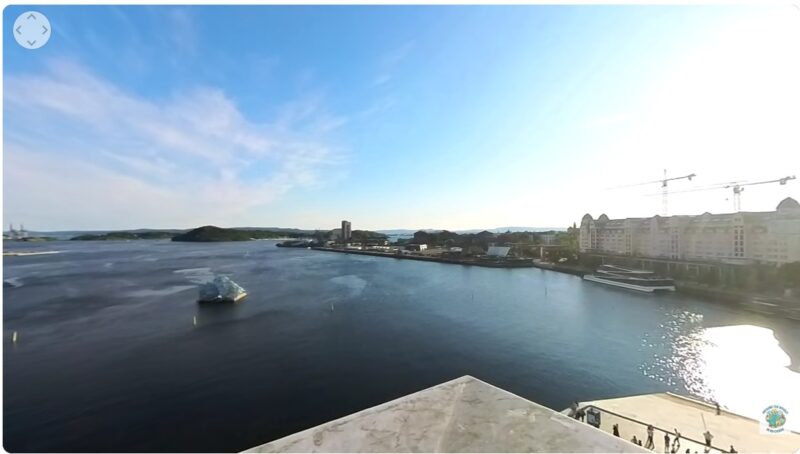
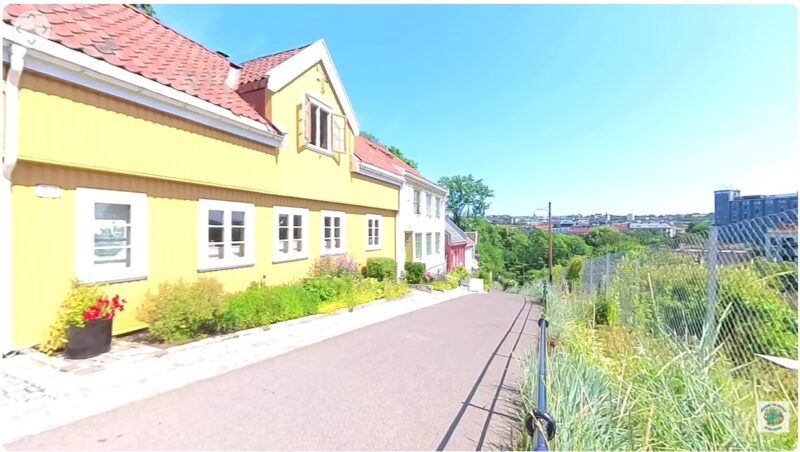
Down on the waterfront I found the Opera House, a vast slab of white marble and glass that famously lets you to walk on it — its roof slopes gently down to the fjord like a glacier, and Osloensers love spending sunny afternoons clambering to the top for the view. From up there I watched little wooden floating saunas drift past on the water below, chimneys puffing, the odd bather leaping straight off the deck into the cold fjord before scrambling back into the steam. A short stroll away stands the City Hall, that twin-towered brick giant where, every December, the Nobel Peace Prize is awarded – the only one of Nobel’s prizes handed out beyond Sweden’s borders. Nearby, the new Deichman Bjørvika library which was named the “Best New Public Library” by International Federation of Library Associations. And then, I found my favourite corner of all – Telthusbakken – a row of small, brightly painted wooden houses, some of the oldest in Oslo, leaning together on the hillside. Osloensers have been fighting hard to preserve them against the modern city rising up around them.
🎥 Come Experience Oslo with me in VR
Why just read about Oslo when you can stand in it?
I’m bringing you a bit of the city in 360° video – so pick your adventure and have a nose around:
🥽 VR headset: Pop it on and simply look around — up, down, anywhere.
🖱️ Computer: Click and drag with your mouse to look in any direction.
** Tip: Full Screen & Choose the highest resolution your internet connection can manage **
Go on, have a look around. 👇
Into the Valleys: The road to Voss
From Oslo I boarded the train and traveled east.
The train climbs steadily out of the forests and up onto the Hardangervidda, a vast, treeless mountain plateau where snow lingers on the peaks even in summer and the occasional lonely cabin sits alone in the tundra.
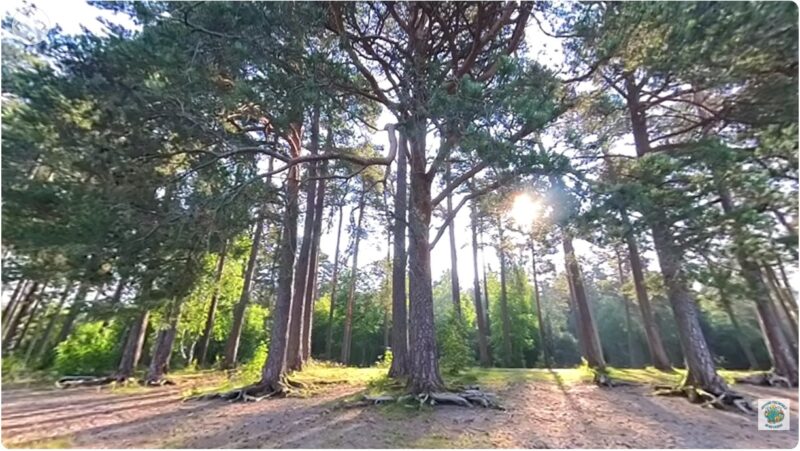
Eventually the train descends towards Voss, a handsome town cradled between mountains and a long, still lake. Voss has a reputation these days as Norway’s adventure capital — skydiving, kayaking, and people in helmets doing alarming things off cliffs.
Experience Voss in VR
Same drill, brand-new view 👇
The Flåm Railway: twenty kilometres of showing off
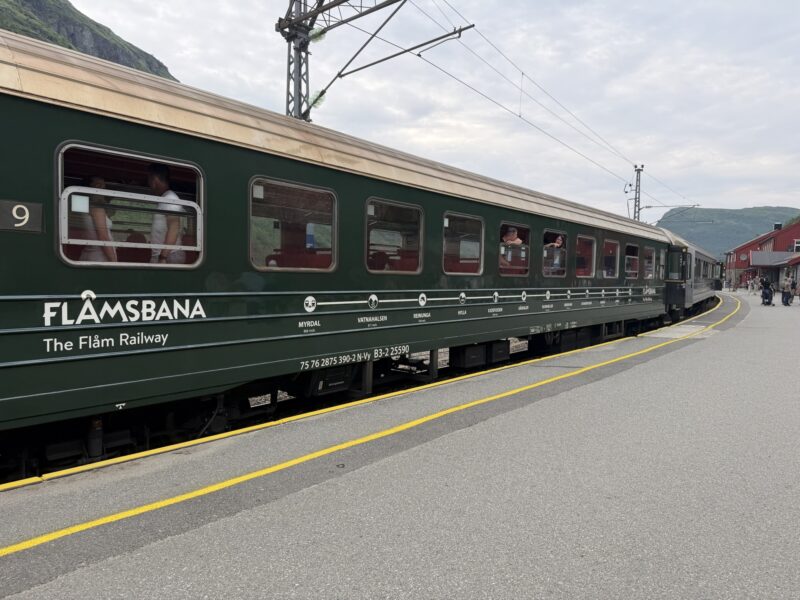
Then came the part I’d been quietly excited about for weeks: the Flåm Railway, or Flåmsbana.
On paper it sounds modest – a little branch line, just over 20 kilometres long, running from the mountain station at Myrdal down to the fjord village of Flåm. It’s been dubbed “the most scenic train journey on earth”.
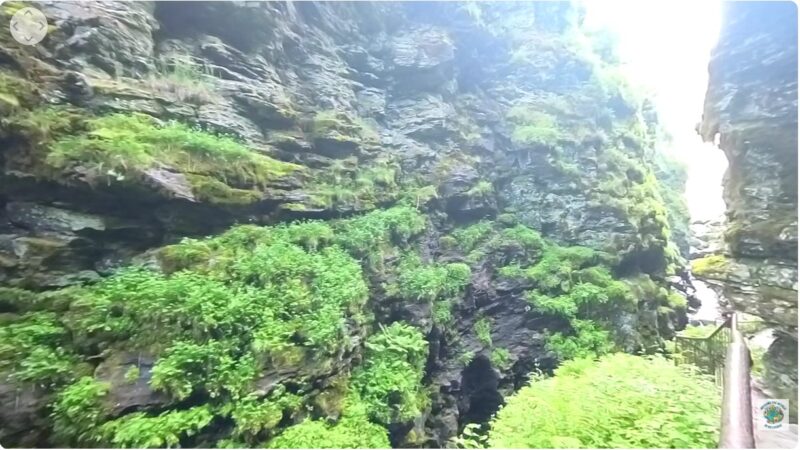
In that short distance, the train drops around 865 metres, making it one of the steepest standard-gauge railways in the world. It corkscrews through twenty tunnels — eighteen of them hacked out by hand between the 1920s and 1940, at a pace of roughly one metre per man per month. When you learn that, you look at the rock walls rather differently.
Halfway down, the train pauses at the Kjosfossen waterfall, a thundering cascade that sends spray straight into your face as you step onto the little platform. And then, right on cue, something wonderfully theatrical happens: a Huldra in a red dress appears on the rocks amid the mist and begins to dance, while eerie music drifts from hidden speakers. The Huldra — a seductive forest spirit from Norse folklore who, legend says, lures men into the mountains. It’s gloriously over the top, and I loved every second of it.
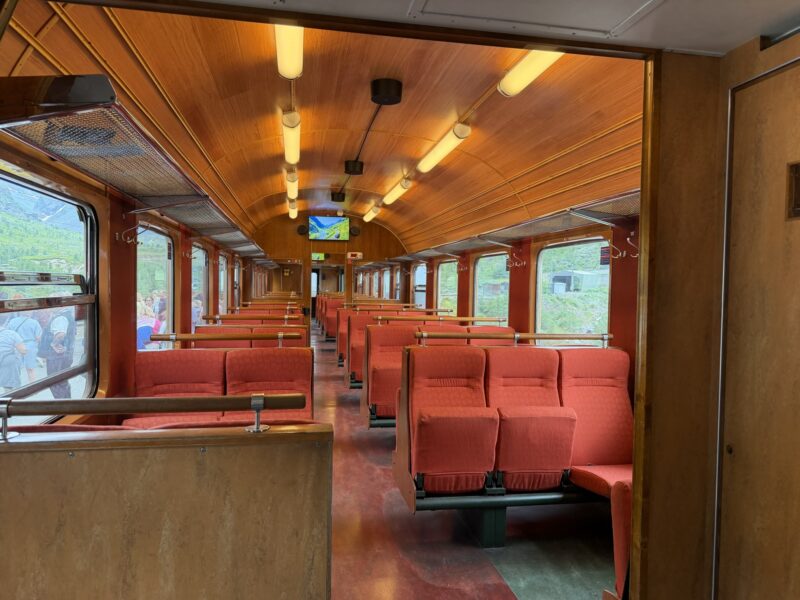
By the time the train rolled into Flåm, tucked at the head of the Aurlandsfjord, I’d more or less given up trying to photograph everything and simply sat with my nose to the glass.
The fjords: Norway at full volume
From Flåm, I swapped rails for water, boarding a ferry to cruise deeper into the fjords.
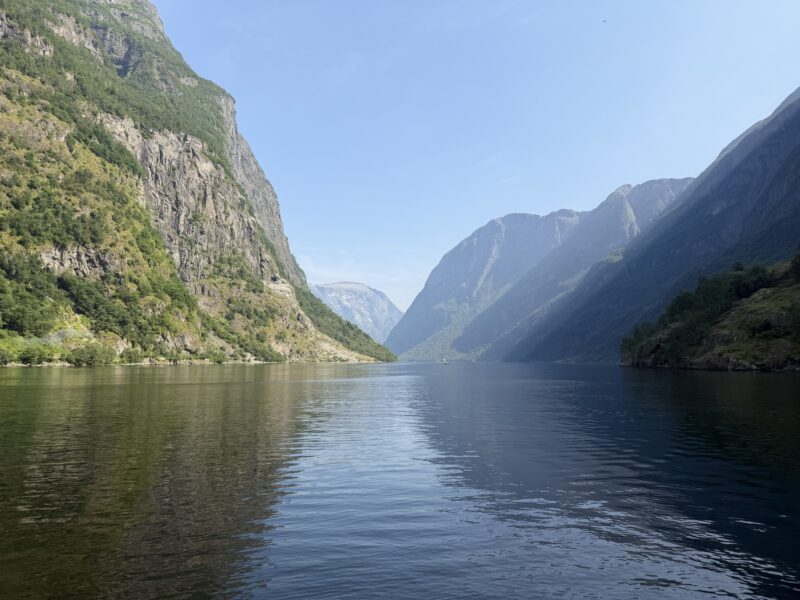
The boat glides out of the Aurlandsfjord and into the Nærøyfjord, a UNESCO World Heritage site and one of the narrowest fjords in Europe. At its tightest, the water pinches to just a couple of hundred metres wide, while sheer cliffs soar up to 1,700 metres on either side.
You can hear the waterfalls tumbling down the rock, the cry of birds, the occasional bell from a church perched on a green ledge halfway up a mountain.
Bergen: the rainy old port at the end
And then, finally, Bergen – our grand finale, and for me, Norway’s soul made of timber.
Bergen is one of the rainiest cities in Europe, raining 239 days per year. Unbelievably, it didn’t rain a single drop while I was there.
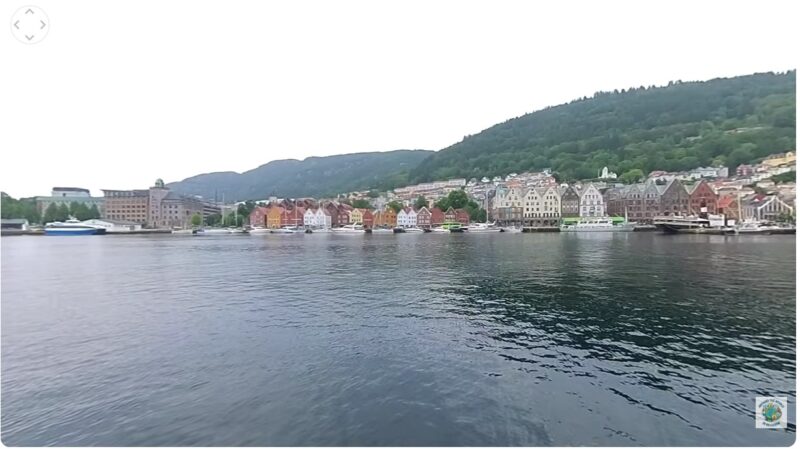
The heart of it is Bryggen, the old Hanseatic wharf – that famous row of crooked, colourful wooden buildings leaning gently on one another along the harbour. Bergen was once a major hub of the Hanseatic League’s trading empire, and from the 14th to the 16th centuries, German merchants controlled the lucrative trade in dried cod from Norway’s far north from precisely this spot. Wander into the narrow wooden passageways behind the painted facades and you step back seven hundred years — the timbers creak, the alleys tilt, and the whole place smells faintly of salt and age.
A few minutes away sits the fish market, where the sea comes ashore each morning and you can eat prawns practically dropping from the boat. After days of mountains and fjords, there was something perfect about ending at the water’s edge, watching the fishing boats come and go under a grey Bergen sky.
🎥 Step Into Bergen With Me
The rainy old port at the end of the line — now in glorious 360°. Grab your umbrella (metaphorically) and take a look around 👇
Coast to coast
Norway from Oslo to the sea isn’t really about the miles. It’s about watching a whole country reveal itself, one view at a time — and realising, somewhere along the way, that you’ve fallen for it.
A Handwritten Adventure Delivered to Your Door
Every month, a beautifully handwritten postcard sent from a different corner of the globe — penned by real people, in real places, with real stories to share.