The Christmas countdown is ON! 

Hop aboard our “Around the World Holiday Express”  as we explore the end-of-year traditions from across the globe!

First Stop🚂: Netherlands!
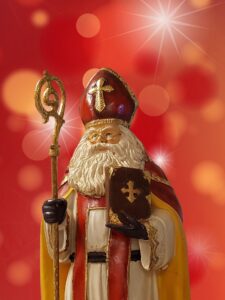
Sinterklaas is a Dutch tradition, really for children. It starts already mid-November, when he arrives, and it goes until the evening of December 5. That’s the big day.
It’s a really big celebration for kids – they get presents, they get sweets, but only if they behave. If you are naughty, no gifts.
Origins of the Legend
The story is from Saint Nicholas, a bishop in the 4th century, from Myra — that’s in Turkey today. He was famous because he helped poor families, gave money secretly, and there are legends he even brought dead children back to life.
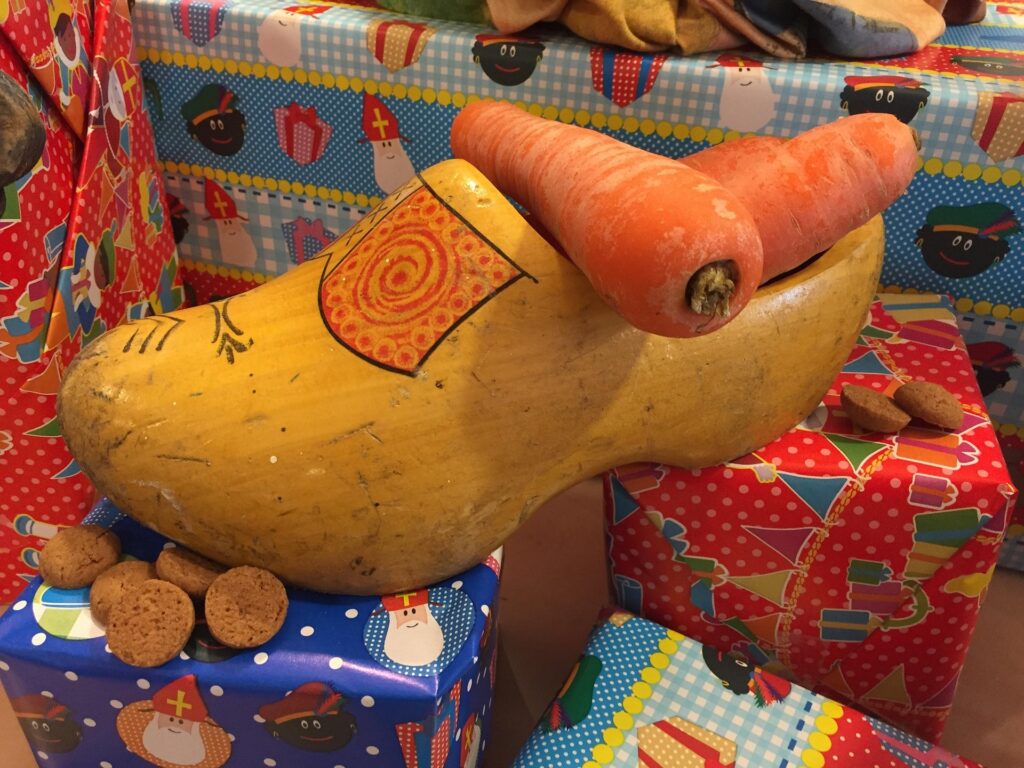
In the Middle Ages, people gave money to the poor, putting it in their shoes. Later this became presents for children.
When the Netherlands became Protestant, Catholic feasts were forbidden. But Saint Nicholas never disappeared. He stayed, somehow, in the culture.
How it became like today
Already in the 1600s you see paintings of children getting sweets and gifts. But the way we know it now really comes from the 19th century. In 1850 there was a children’s book, Sint-Nicolaas en zijn knecht. That book showed him with a servant, and from there the modern Sinterklaas tradition grew.
Santa Claus Connection
Everybody knows Santa Claus, but he actually comes from Sinterklaas. Dutch settlers brought the tradition to America. The name “Sinterklaas” changed into “Santa Claus.” And then in the US he became something else: living at the North Pole, with elves, reindeer, sleigh.
The helpers
Now, this is where it gets complicated. Traditionally, Sinterklaas had helpers called Zwarte Piet — Black Pete. In the 19th century they were drawn as Moorish servants, with dark skin, big lips, earrings. That was how people looked at Africans in the colonial time.
I remember when I was in the US, in Cincinnati, for my thesis. My mom sent me some Dutch sweets, and on the package there was Black Pete. People there were shocked. I had no idea before that it was seen as racist. In Holland we didn’t think about it. But now people are more aware, and Piet is often shown with soot on his face, like he came down the chimney. That feels better.
The arrival
Every year in mid-November, Sinterklaas arrives from Spain. He comes on a steamboat, with his horse (used to be Amerigo, now Ozosnel) and his helpers.
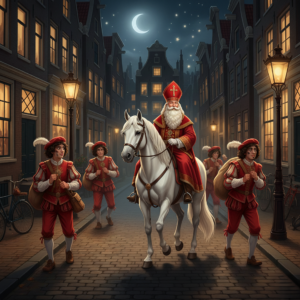
It’s a big show on TV, every year in a different town. There is always some drama — the boat is late, or the presents are lost — but in the end it works out.
After that, he rides his horse through the streets, and the helpers throw sweets to the children.
- Kruidnoten (tiny spiced cookies)
- Speculaas (biscuits)
- Marsepein (marzipan)
- And of course the chocolate letter — the first letter of your name, in chocolate.

The build-up
From the arrival until December 5, children put their shoes out. You sing a song, and in the morning maybe there is a gift or sweet inside.
There is even a daily TV program, Sinterklaasjournaal, with news about what happened that day. Kids love it, it builds the excitement.
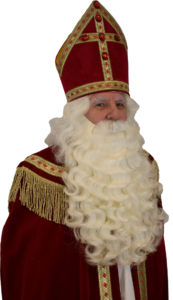
Pakjesavond
December 5 is Pakjesavond, the evening of presents. Families come together, and suddenly the gifts arrive.
Parents make it special. I remember when I found out how my mom did it — I was shocked. She used to climb out of the window, then come back through the front door while we were distracted with sweets. Suddenly the hallway was full of presents.
Even when you are older, the tradition continues, but the gifts are smaller.
The day after
December 6 is not a holiday, so kids go to school. But of course they talk about all the presents they got the night before.
So…
Sinterklaas is really a mix: a bishop from Turkey, arriving from Spain, riding a horse in Holland, and somehow connected to Santa Claus at the North Pole. But for Dutch children, the magic is always the same: sweets, songs, and gifts on December 5.
A Handwritten Adventure Delivered to Your Door
Every month, a beautifully handwritten postcard sent from a different corner of the globe — penned by real people, in real places, with real stories to share.