Park Güell: A Failed Housing Development, a Modernist Dreamscape
One of the things I love most about Barcelona is that its history isn’t tucked away behind glass cases – it’s out in the open, baked into the hillsides, tiled across benches, and spiralling up in improbable shapes that make you wonder whether the architect was a genius, a madman, or both. Park Güell is perhaps the best example of this. You don’t so much visit it as wander into a world where the city’s past ambitions and its artistic imagination collided and decided to stay put.
Before coming, I’d always thought of Park Güell as “that Gaudí park with the lizard and the wiggly bench.” But the story behind it is far richer, and in a very human way, far messier. It begins with Eusebi Güell, an industrialist with deep pockets and even deeper cultural aspirations, and Antoni Gaudí, the architect who could turn stone into poetry and geometry into something that looked alive. Their partnership started in the late 1870s, when Güell spotted a window display Gaudí had designed for a Paris exhibition. Something in that display — its boldness, its strangeness — convinced him he’d found the architect who could give shape to his dreams.
Over the years, Güell kept giving Gaudí bigger and bolder commissions: a palace in the old city, a winery, a church for his factory workers, and finally, in 1900, the project that would become Park Güell. The two men weren’t just patron and architect; they were friends, collaborators, and in many ways co‑conspirators in the great Modernisme movement that was reshaping Barcelona at the turn of the century.
And what a Barcelona it was. By 1900 the city had burst out of its medieval walls and was reinventing itself with the vast Eixample grid – a modern metropolis powered by industry, ambition, and a hunger for cultural renewal. Modernisme wasn’t just an architectural style; it was a declaration that Catalonia was stepping confidently into the future while holding tight to its own traditions. Gaudí, with his impossible curves and nature‑inspired forms, became its most distinctive voice.
Park Güell was meant to be a garden city – a utopian housing development perched on a hillside, where the wealthy could live among fresh air, winding paths, and sweeping views. It never quite worked out that way. Only two houses were ever built, one of which Gaudí himself lived in. But the failure of the real‑estate scheme turned out to be a gift to the rest of us. What remains is a kind of open‑air manifesto: Gaudí’s ideas about nature, architecture, and community laid out across terraces, viaducts, and mosaics.
Walking through it today, you can still feel the optimism of that era – the belief that a city could be modern without losing its soul, that tradition and innovation could sit side by side, and that beauty was something worth building into everyday life.
That’s where my visit began.
Walking Through Park Güell
The High/Middle/Low Viaduct — Gaudí’s Mountain Motorway
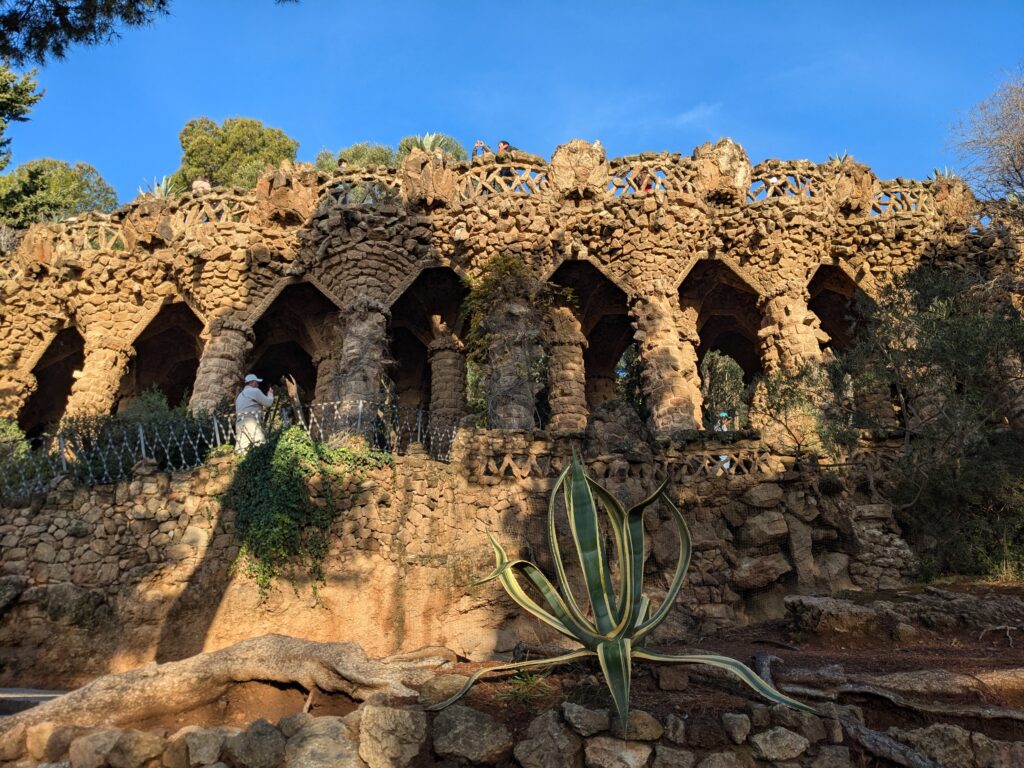
My first stop was the Pont de Dalt, the High Viaduct, which looks as though it grew out of the hillside rather than being built on it. Gaudí designed a three‑kilometre network of roads to stitch the estate together, and the viaducts are the most striking remnants of that plan. They’re made from the very stone they stand on, which gives them the uncanny feeling of being both architecture and geology.
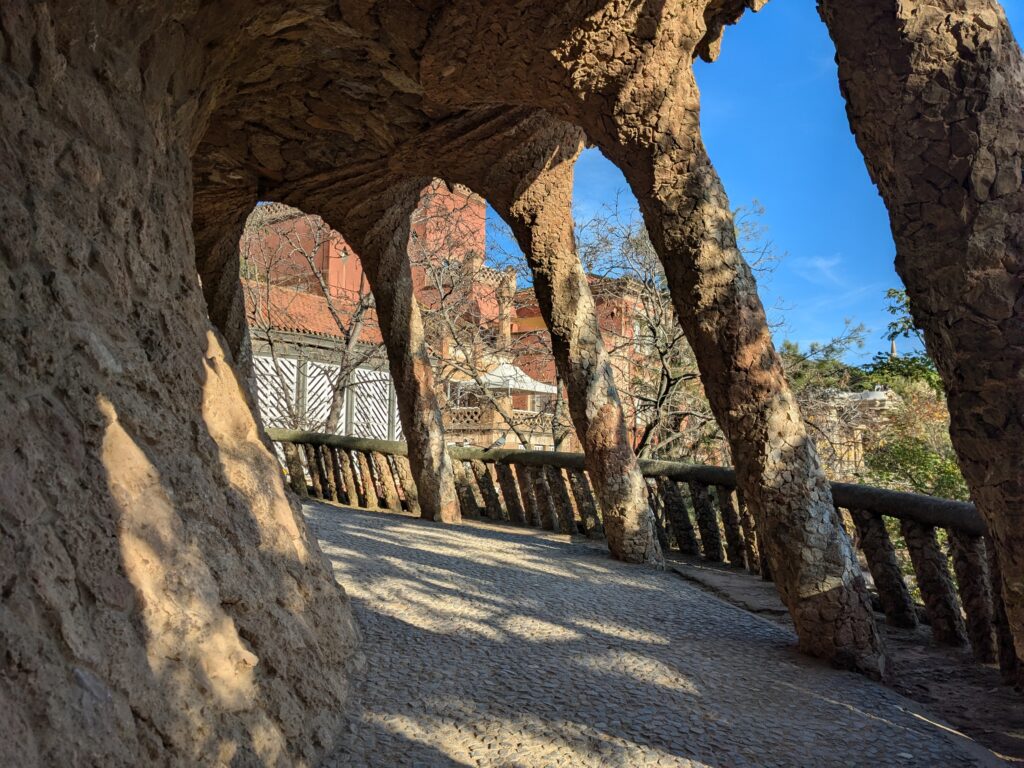
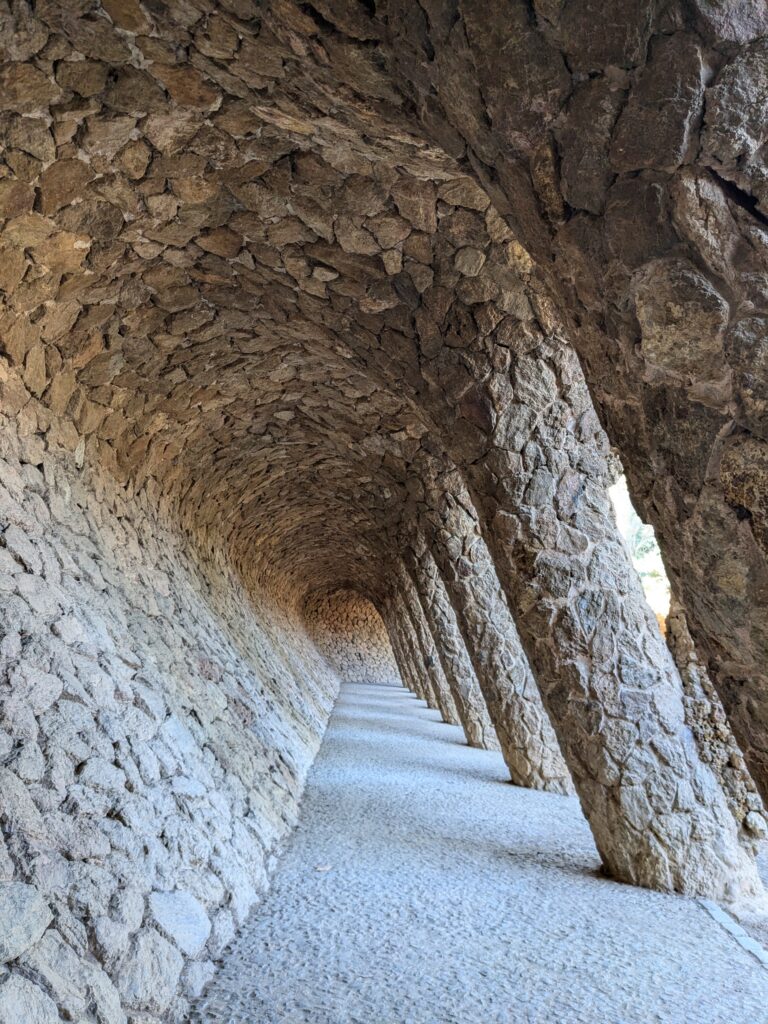
Further down is the Middle Viaduct, where Gaudí leans fully into his favourite trick: making man‑made structures look like natural caves. The columns tilt like tree trunks caught mid‑sway, and the whole thing doubles as a retaining wall for the mountain. Above, carriages once trundled along; below, you can shelter from the rain. It’s practical, theatrical, and slightly surreal – very Gaudí.
The lowest of the three viaducts is the most elegant. Its curved line forms a parabola when you include the central vault, and the slanted columns give it a sense of movement. Gaudí even built rainwater‑capture systems into the structure, feeding tanks hidden inside the viaducts. On the outside, small columns support balustrades dotted with planters, a reminder that for Gaudí, architecture was always in conversation with nature.

Casa Trias — The Only House That Sold
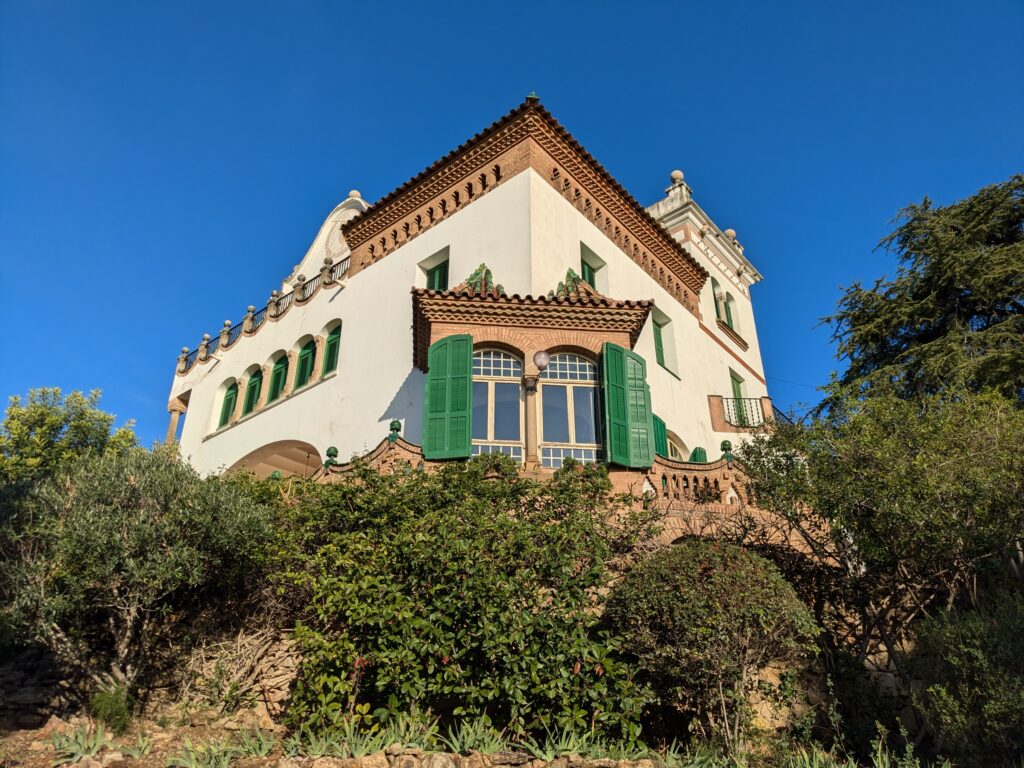
Tucked away on one of the only two plots ever purchased is Casa Trias, designed by Juli Batllevell. It belonged to Martí Trias i Domènech, the Güell family’s lawyer – a man who clearly had faith in the project long before the rest of Barcelona did. It’s not open to the public as it’s still privately owned by his descendants, which gives it a slightly mysterious air.
The Hill of the Three Crosses — A Chapel That Never Was
At the very top of the park, 182 metres above sea level, is the Hill of the Three Crosses. Gaudí originally planned a chapel here, but when the housing development collapsed, the idea was abandoned. Instead, three stone crosses were erected, forming a kind of improvised Calvary. The view from up here is spectacular — the city spread out below, the sea beyond it — and you can almost imagine the chapel that never materialised.
Ramp by the Larrard House — A Path That Moves Like Water
Heading back down, I followed one of the ramps near the old Larrard House, Güell’s former residence. These paths are so perfectly integrated into the landscape that you barely notice how cleverly they’re engineered. The viaducts, Pont de Baix, Pont del Mig, and Pont de Dalt, snake up the mountain in five‑metre‑wide ribbons, supported by slanted columns and rough‑hewn stone vaults. They were designed for carriages, but today they feel like something between a woodland trail and a sculpture.

The Laundry Room Portico — A Wave Turned to Stone
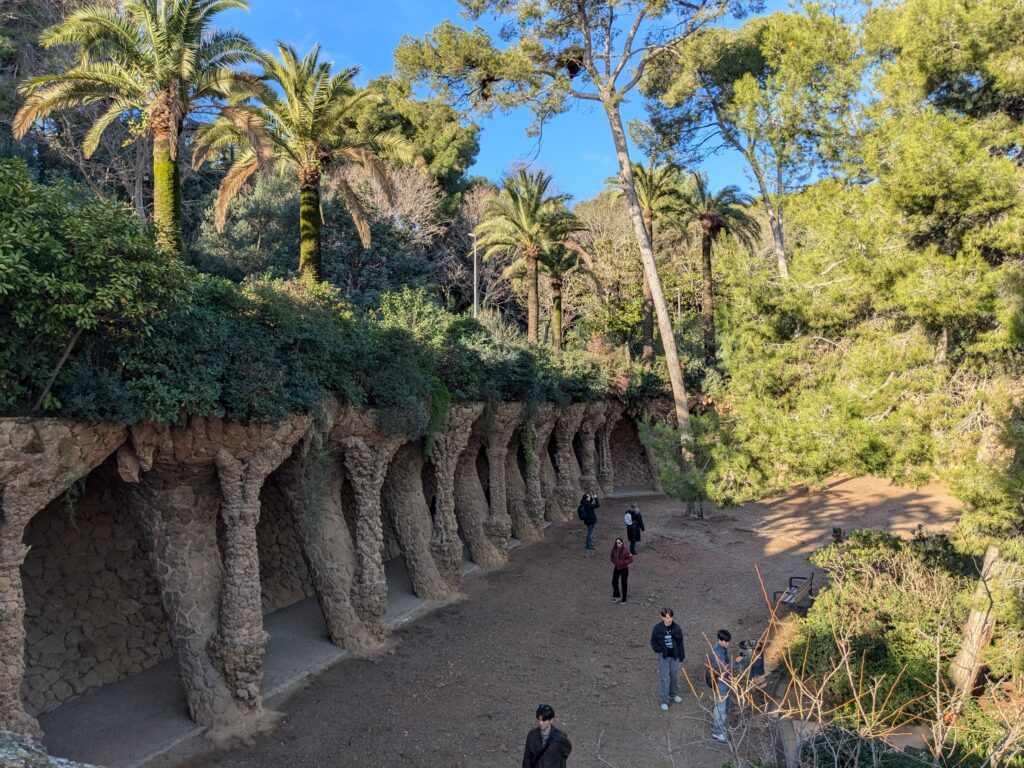
One of my favourite corners of the park is the Laundry Room Portico, named after the sculpted figure tucked into one of its columns. The portico curves like a giant wave frozen mid‑crash, supported by slanting pillars that look as though they’re bracing themselves against the tide. It’s one of the clearest examples of Gaudí’s organic architecture — structure and sculpture fused into one. Walking through it feels like stepping into a cave carved by the sea.
The Greek Theatre / Nature Square — A Stage for the City
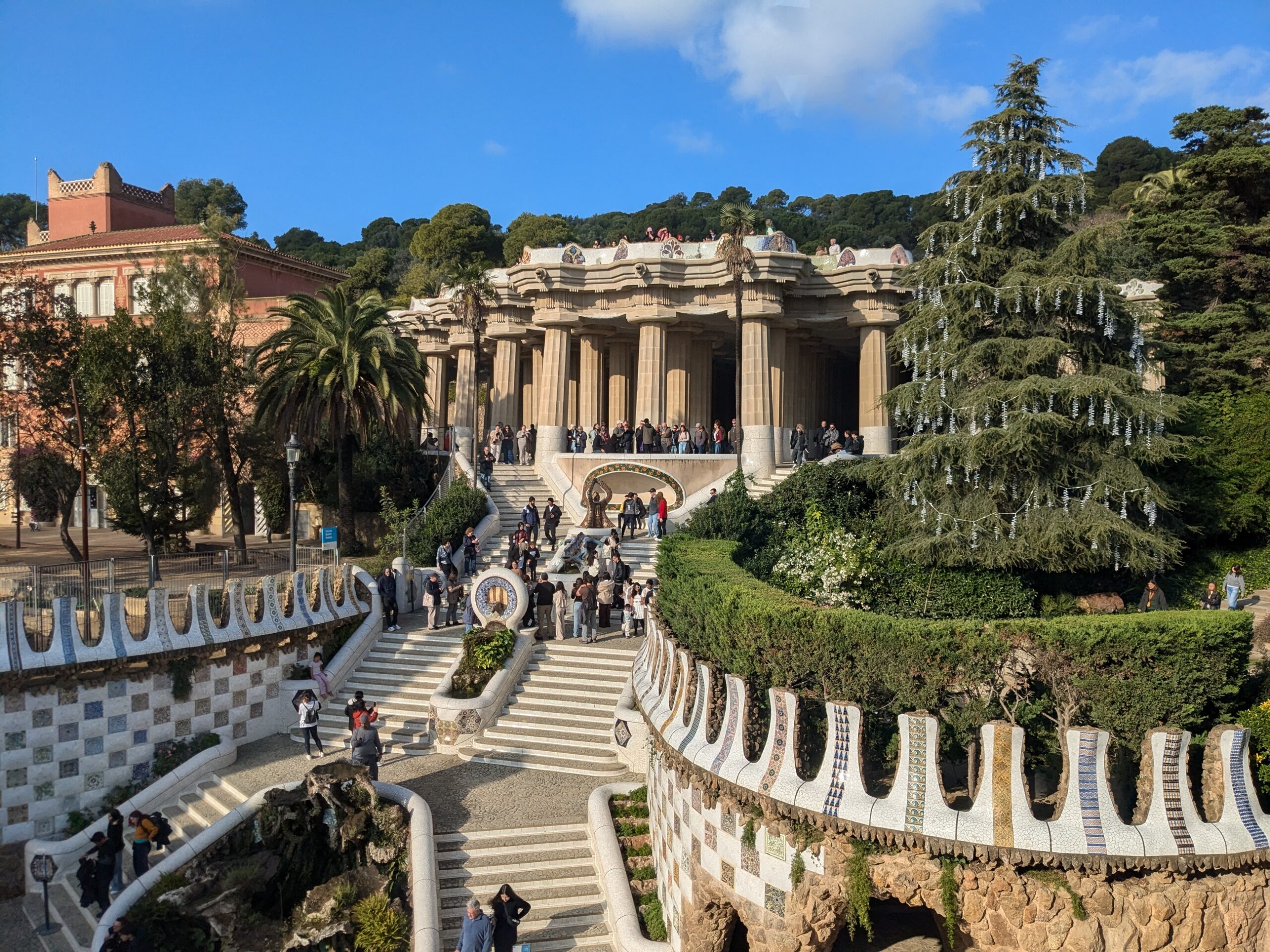
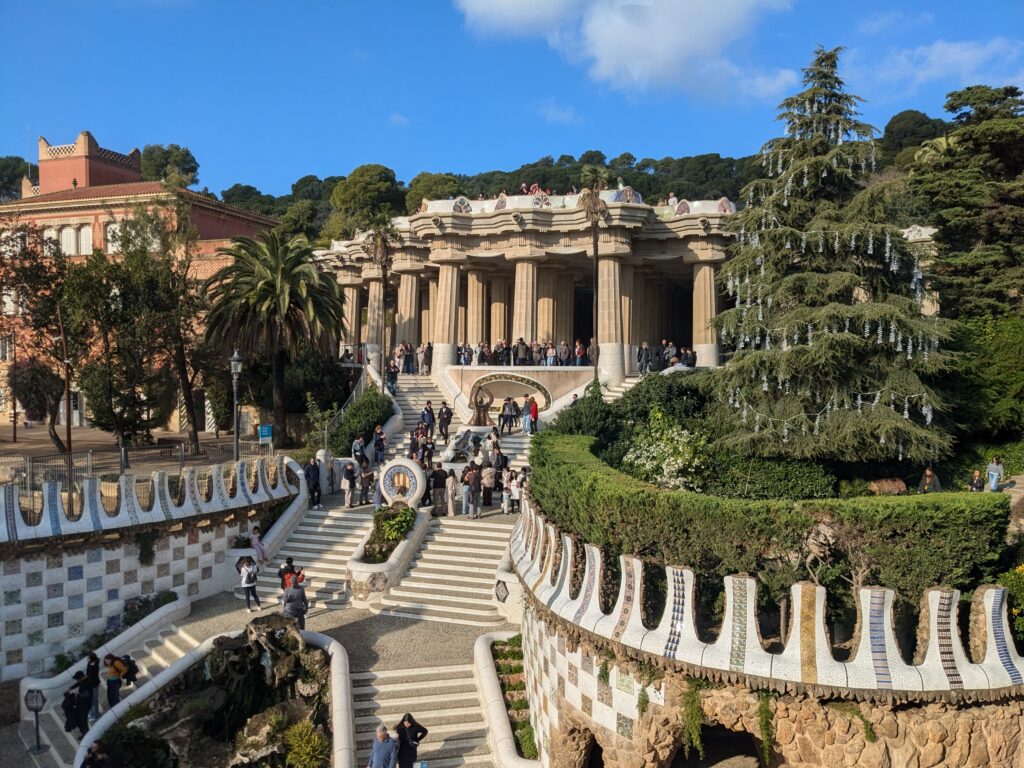
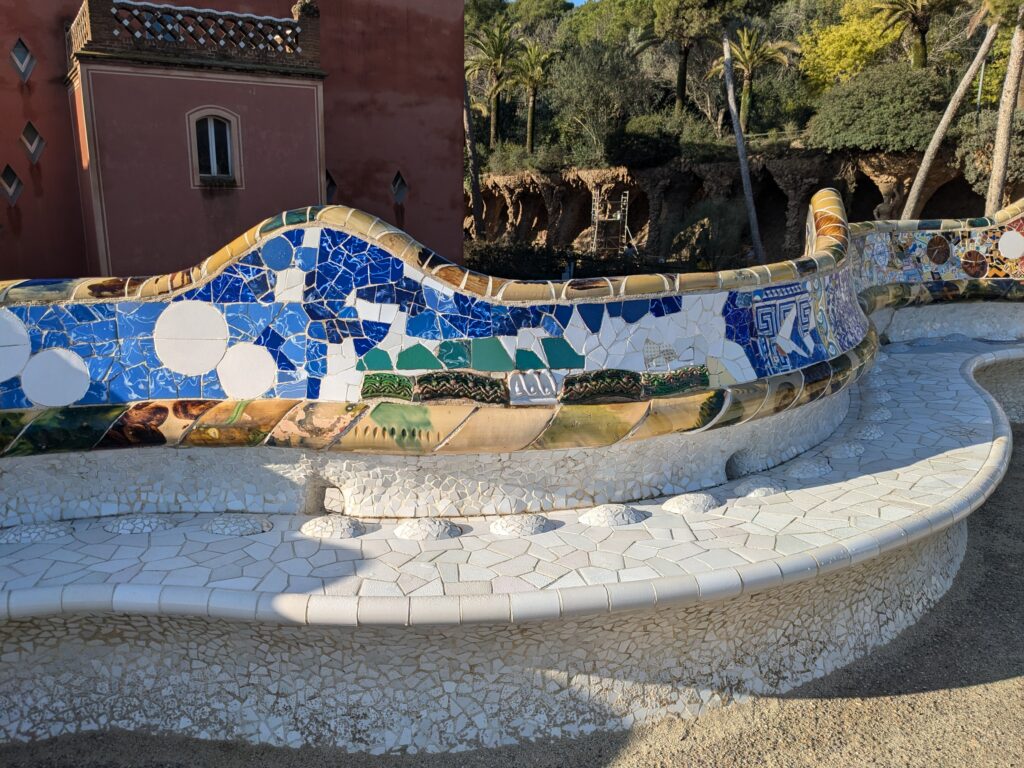
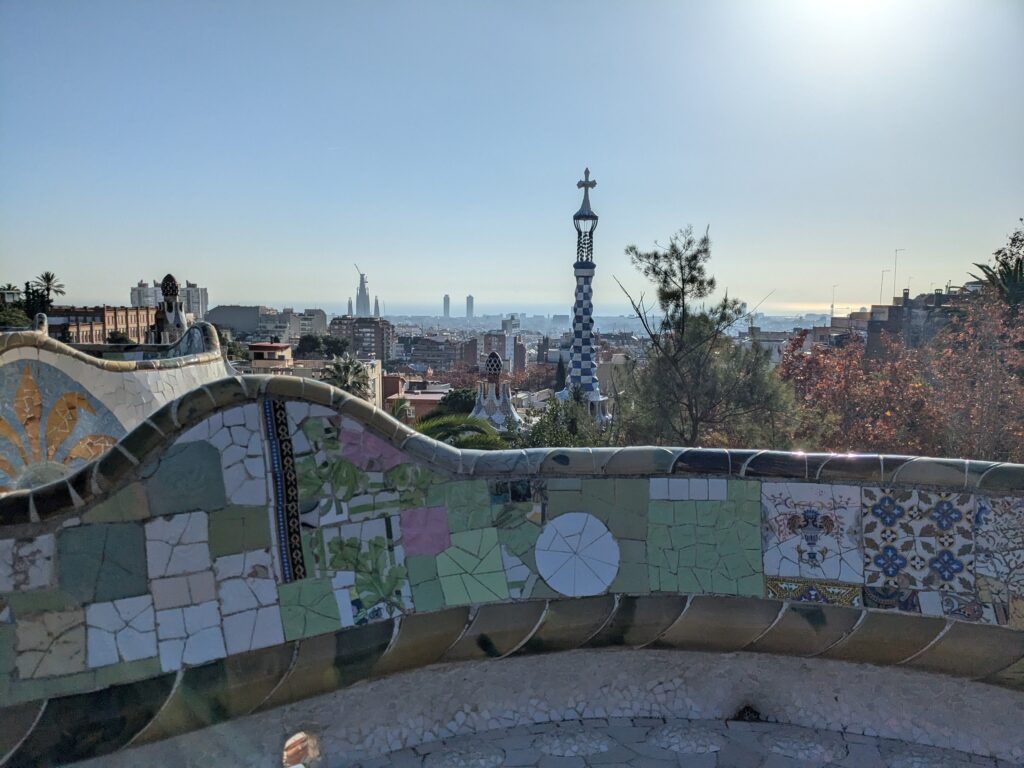
At the heart of the park is the great esplanade once called the Greek Theatre, now known as Nature Square. It was meant for open‑air performances, with the surrounding terraces acting as natural seating. The square itself is partly carved into the rock and partly suspended above the Hypostyle Room. The undulating bench that borders it, covered in broken‑tile mosaic by Josep Maria Jujol, is one of the most joyful pieces of design in Barcelona. Sit anywhere along it and you get a panoramic view of the city, framed by a riot of colour.
The Hypostyle Room — A Forest of Columns
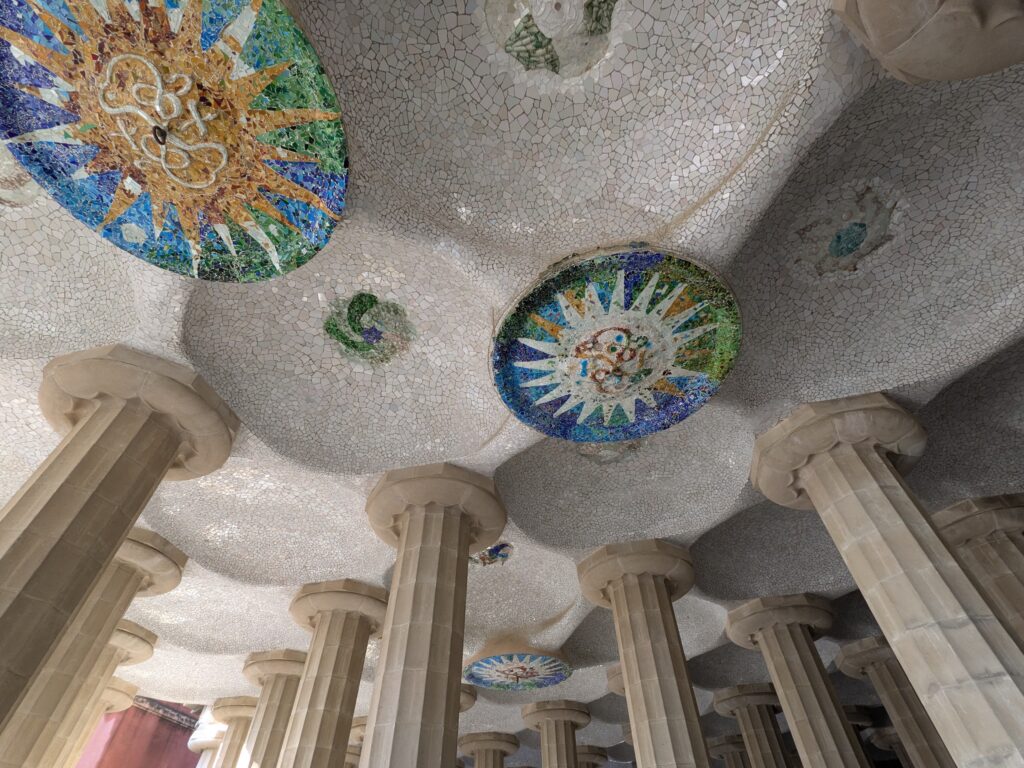
Beneath the square is the Hypostyle Room, a forest of 86 Doric‑inspired columns that support the terrace above. It was originally intended to be a marketplace for the housing estate, which feels wonderfully optimistic in hindsight. The ceiling is decorated with mosaic medallions, and the acoustics are so good that even a whisper seems to travel. It’s both monumental and strangely intimate.
The Dragon Stairway — The Park’s Most Famous Resident
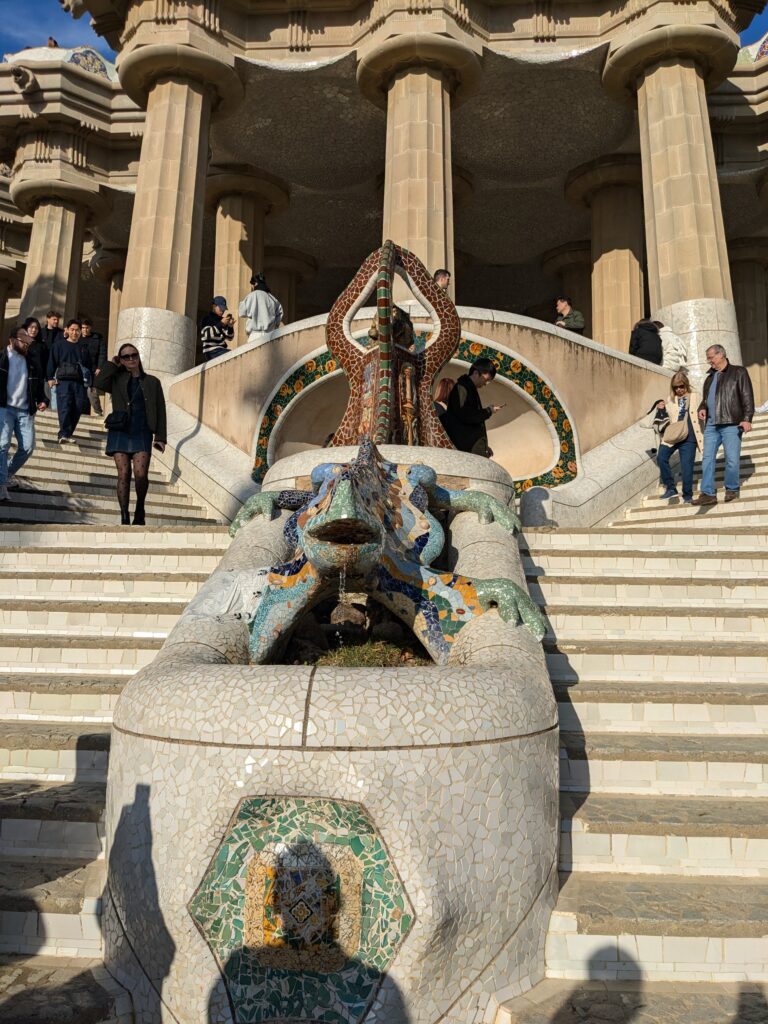
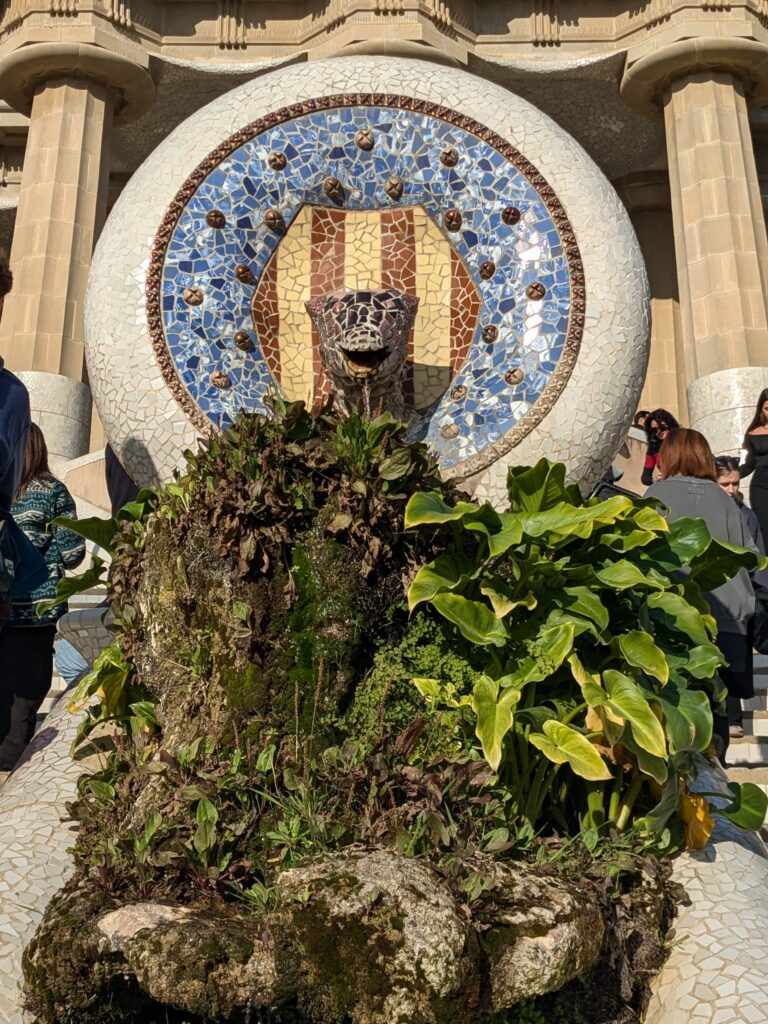
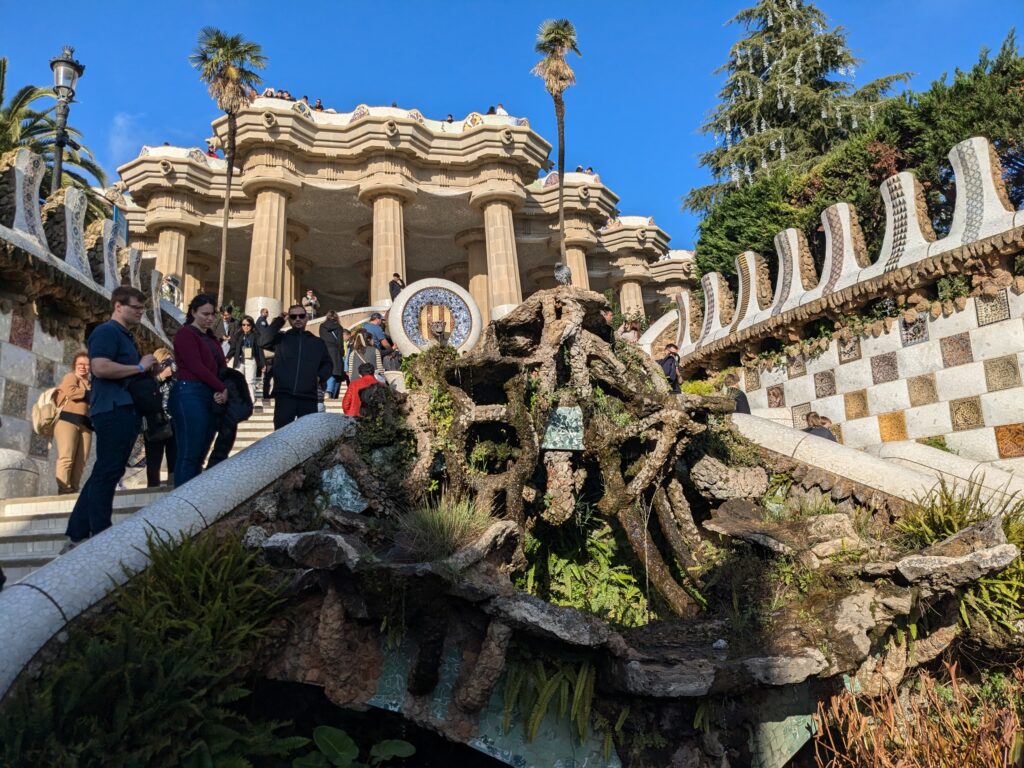
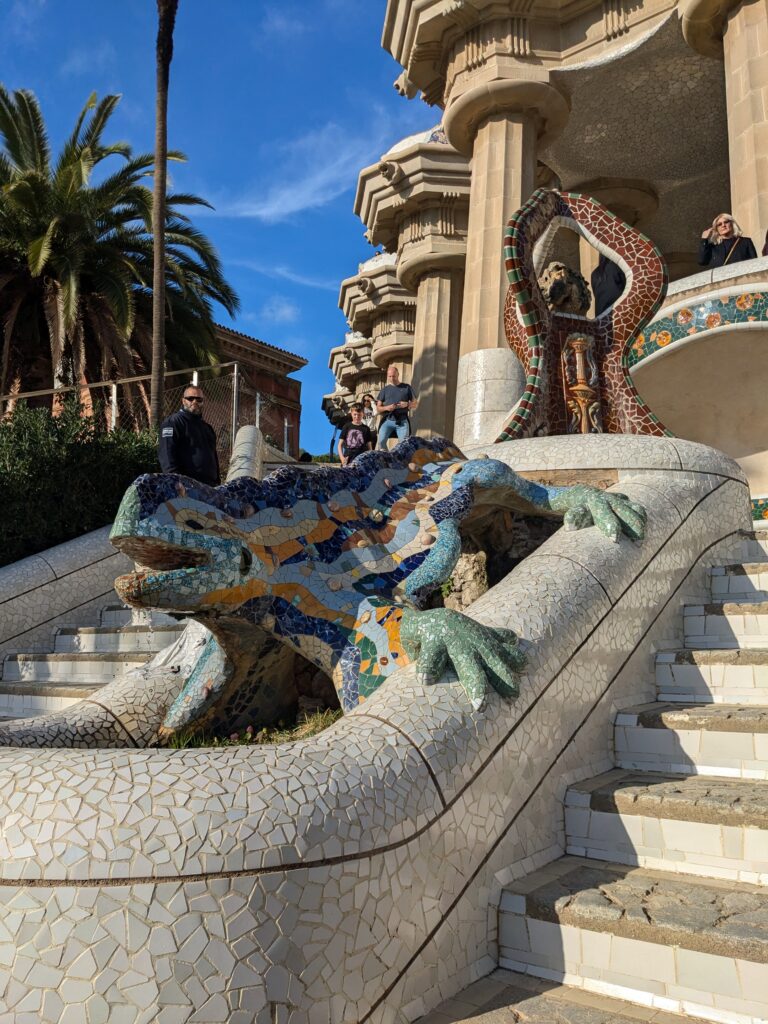
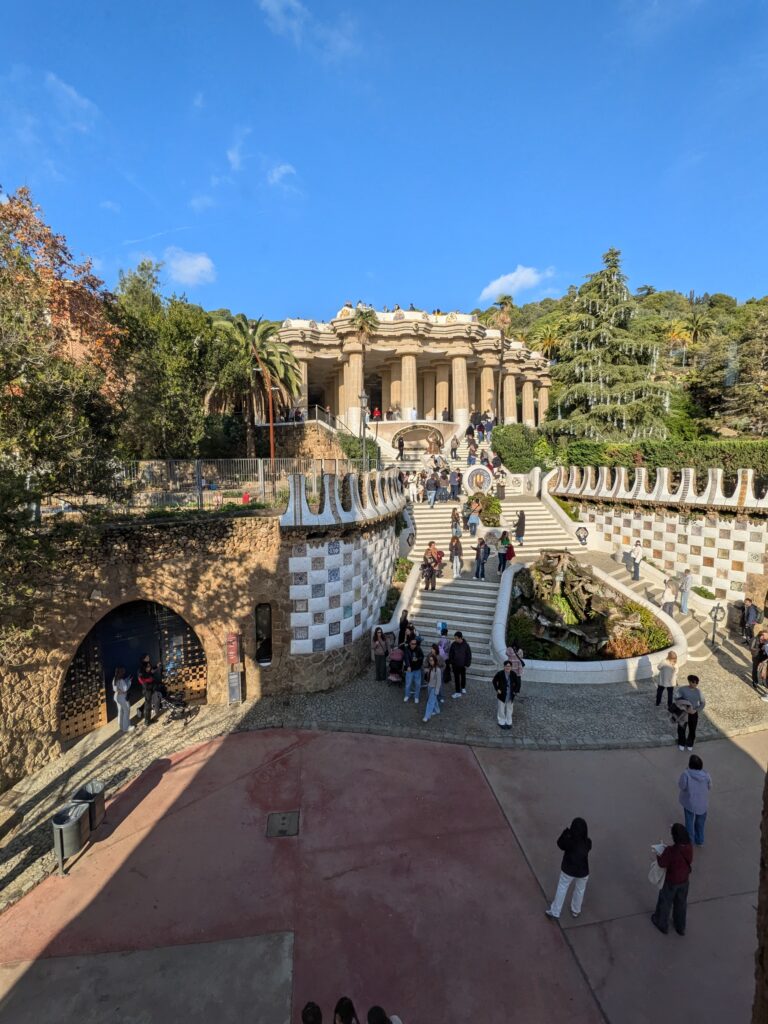
From the main entrance, a grand stairway rises in three sections, flanked by walls with crenellated terraces and two grottoes beneath. Water once flowed down the centre from the tank hidden under the Hypostyle Room. Halfway up is the emblem of Catalonia, and just above it, the park’s most photographed inhabitant: the dragon, or salamander, covered in colourful trencadís mosaic. It’s whimsical, slightly absurd, and utterly irresistible. At the top, sheltered under the Hypostyle Room, is a small odeon, a nod to the park’s theatrical ambitions.
The Porter’s Lodge Pavilions — A Fairytale Entrance
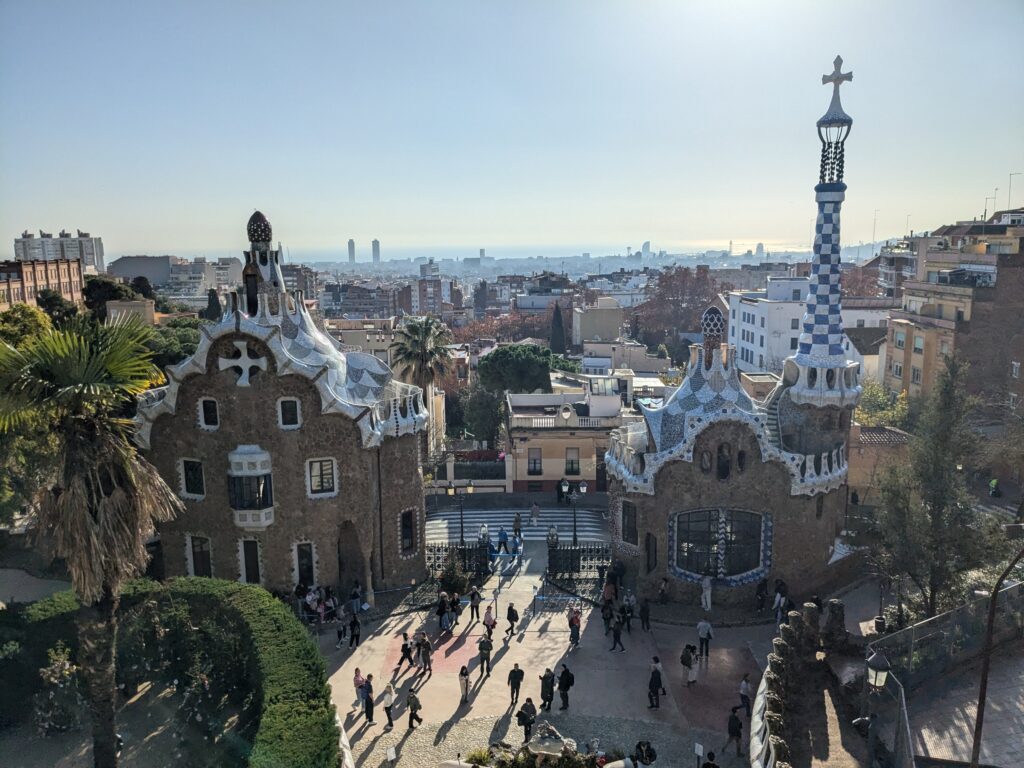
Finally, the main entrance on Carrer d’Olot is guarded by two pavilions that look as though they’ve wandered out of a storybook. One served as the porter’s lodge, complete with waiting room and telephone booth; the other was the porter’s residence, now part of the city’s history museum. Their roofs, covered in trencadís mosaic, shimmer in the sunlight like something between gingerbread and coral. The iron gates shaped like palm leaves originally came from Casa Vicens — a reminder that Gaudí never wasted a good idea.
By the time I made my way back toward the gates, the sun was beginning to slip behind the city, and Park Güell had taken on that late‑afternoon glow that makes everything look slightly enchanted. It struck me that the park is less a collection of monuments and more a conversation — between architecture and landscape, between ambition and reality, between two men, Güell and Gaudí, who genuinely believed that beauty could shape the way people lived. The housing development may have failed, but the dream survived in a different form, one that thousands of people wander through every day without quite realising they’re walking inside a manifesto.
As I headed downhill, past the dragon and the porter’s lodge and the last of the trencadís tiles catching the light, I found myself thinking that Park Güell is exactly the sort of place that rewards curiosity. It doesn’t give up its stories all at once; it lets you discover them slowly, in the curve of a bench, the tilt of a column, the way a viaduct blends into the hillside. And that, for me, is the joy of it — a park that invites you to look closer, wander further, and leave with more questions than you arrived with.
A very Gaudí ending, really.